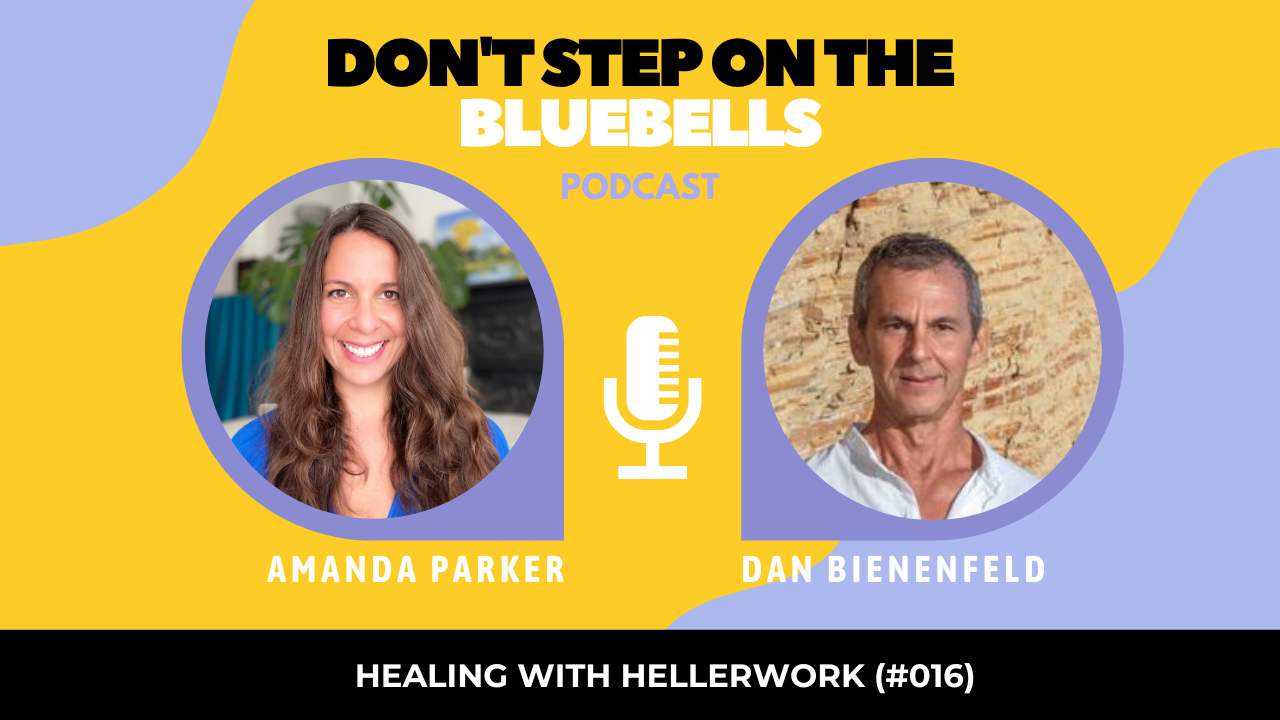
#016 Hellerwork Explained: Deep Bodywork for Structural Healing — Daniel Bienenfeld
Listen to full episode
In this episode, Amanda Parker interviews Daniel Bienenfeld, a Hellerwork practitioner and teacher, who shares the principles of this unique bodywork modality and offers a powerful fascia activation technique for self-care. With wisdom and compassion, Daniel discusses the journey of healing through embodiment and guides listeners to experience the richness of living from a place of wholeness.
Read the full Show Notes below!
Subscribe Now
“The body is where we feel life from. And we can’t think life, we feel life. And if anyone is suffering from lack of energy, come back to your body.”
Today's Guest
DANIEL BIENENFELD
Dan Bienenfeld is a world renowned Somatic Therapist and Hellerwork Structural Integration trainer and practitioner with over 45 years of experience. He is past president of the Hellerwork Practitioner’s Association, and a training director for Hellerwork International.
Dan’s decades of experience in working with thousands of people has given him valuable insight into the healing arts and insight into the art of healing. He was co-founder of Los Angeles Healing arts Center, one of the nations’s largest multi specialty alternative medical centers.
Dan has worked in developing Ergonomic programs for Fortune 500 companies such as Johnson and Johnson. He is an Author of Align for Life, Journey to Structural Integration and 9 ebooks, and is passionate with his private practice in Los Angeles and facilitates seminars internationally on Somatic Healing practices and Structural Integration.
How to get in touch:
Website (Dan’s Work): www.embody365.com
Website: www.hellerwork.co
Instagram: @embody365

Listen to the episode on
Show Notes
In this episode of Don't Step on the Bluebells, Amanda Parker interviews Dan Bienenfeld, a practitioner and teacher of Hellerwork structural integration. Dan explains that Hellerwork is a unique bodywork modality that works with the whole body to realign it with gravity, restoring space, function and ease of movement. While hands-on work from a trained practitioner is ideal, Dan also shares a powerful fascia activation self-care technique that anyone can use to awaken the body and release held patterns of physical and emotional pain.
Dan's own journey with Hellerwork began as a teenager, when he witnessed the dramatic changes in a friend who went through the process. He knew clearly then that this was his path, and ended up being one of the first students of Joseph Heller, the creator of Hellerwork. His advice for someone starting to connect with their body is to begin scanning and noticing sensations throughout the day, while seeking support from experienced practitioners.
The conversation touches on the nature of healing, which Dan distinguishes from fixing. True healing, he suggests, comes from having the courage to feel and listen to the messages of the body, bringing awareness, acknowledgment and space to areas of discomfort and stuckness. This is deep, ongoing work, but it is what allows us to experience the richness of life fully embodied. Dan's warm, down-to-earth wisdom invites listeners to begin that journey back to wholeness.
Key Takeaways
Hellerwork is a type of structural integration bodywork that realigns the body with gravity. It works on the whole body, not just symptoms, to restore space, function and ease of movement.
While bodywork from a trained practitioner is ideal, there are self-care practices one can do, including yoga, Pilates, and a fascia activation technique Dan shares. This involves bringing awareness, breath, movement, tapping and more to awaken an area of the body.
The fascia activation technique can be used on areas of physical discomfort or emotional stuckness. Our issues are held in our tissues.
Our bodies hold emotional content and memories, not just physical tension. Bringing awareness and acknowledgment to areas of discomfort or stuckness is a key part of the healing process.
His advice for someone starting a journey of connecting with their body - start scanning and noticing sensations throughout the day. The more awareness you bring in, the more embodied you become. Getting support is valuable too.
Healing is not the same as fixing. Healing involves going into discomfort, giving it a voice, making space and forgiving yourself for holding on. Coming back to the experience of living from and feeling through the body makes life richer and more whole.
Committing to the journey of embodiment - feeling and listening to the messages of the body - allows us to experience the richness and wholeness of life more fully. This is a process of coming home to ourselves.
Modalities like Hellerwork, Rolfing, yoga and Pilates can be valuable tools in this process of embodiment, but the most important thing is our own intention and willingness to feel and be present with our whole being.
Daniel's own story demonstrates the powerful clarity and life-changing potential of following the call to your deepest knowing, even if it seems unconventional. His work is an invitation to that same courage and wholeness.
Dan knew clearly as a teenager that he wanted to do this work after seeing the changes in a friend who went through the process. He ended up being one of the first students of Joseph Heller, the creator of Hellerwork.
What We Talked About
What Hellerwork is and how it works with the whole body to realign it with gravity and restore ease of movement, rather than just focusing on symptoms.
The importance of fascia and how to awaken and enliven it through self-care techniques like the fascia activation exercise Daniel guides listeners through.
Daniel's personal journey with Hellerwork, from experiencing it as a teenager to becoming one of the first students of Joseph Heller, the creator of the modality.
Advice for people wanting to start connecting with their bodies, including scanning for sensations throughout the day and seeking support from experienced practitioners.
The nature of healing as distinct from fixing, and the role of embodied awareness, feeling, and listening to the body's messages in the healing journey.
The transformative potential of bodywork modalities like Hellerwork to help people experience the richness of living from a place of embodied wholeness.
Guest Quotes
"In order to work and correct a shoulder problem, we're not just working on the shoulder, we're working on the whole body, the relationship between the shoulder and the rest of the body."
"When we don't move, nothing happens. I mean, Einstein even said, 'Nothing happens until something moves.'"
"The investment is worth it and it's very easy to do. It's just a commitment to, I want to free myself, I want to be here. And so I need to connect with my body because my body will feel what's happening. And there's no way to get around that. If you want to come back, you have to go through your body."
"Healing doesn't mean fixing. Like someone could have a, let's call it a shoulder injury, and they could have healing without it getting fixed. So, healing would represent going into the deeper layers of what's going on with that shoulder."
"I would just invite you to gift yourself with a session of structural integration at some point when the timing is right. Just to see and feel and just as a gift to yourself. And also just to come back. Come back to your body. Come back while you're doing everything else."
"It's pretty amazing when we do that, because even though it takes longer, you can actually make space so that the shoulder is comfortable again. If we're just working on this and loosening it, it doesn't often, sometimes you can get lucky and, you know, pains will go away, but it doesn't necessarily change the shoulder and the relationship with the rest of the body."
"We all have a body. We all have emotions that we've stuffed. We all have fear. The human experience is unique for each person, but it's also very much the same. We all have the same feelings. Getting to know ourselves so that we can actually have a richer life."
"No one ever heals until they let go of the victimization. It's impossible. So the healing starts when you allow yourself to forgive yourself for holding on to something your whole life."
"The body is where we feel life from. And we can't think life, we feel life. And if anyone is suffering from lack of energy, come back to your body."
"You're actually stimulating the emotional content that you're holding in that part of the body... When you allow an area to have its day in court or its exposure, or give it a voice, sometimes that's all something needs in order to let go."
Resources to Learn More
Website (Dan’s Work): www.embody365.com
Website: www.hellerwork.co
If you are unable to find a Hellerwork practitioner in their area, Dan suggests looking up structural integration, as there are many good schools and practitioners in this broader field who can provide similar benefits
Terms & Tools to Dig Deeper
Fascia: The connective tissue that surrounds and supports muscles, organs, and other structures in the body. It plays a crucial role in movement, posture, and overall health.
Fascia Activation Technique (also called Fascia Integration Technique or Fascia Flow Technique): A self-care practice that involves bringing awareness, breath, movement, tapping, and other elements to awaken and enliven a specific area of the body or the whole body. This technique helps to release held patterns of physical and emotional pain.
Fascia Flow Technique: Another name for the Fascia Activation Technique (see above).
Fascia Integration Technique: Another name for the Fascia Activation Technique (see above).
Hellerwork: A type of structural integration bodywork that aims to realign the body with gravity. It works on the whole body, not just symptoms, to restore space, function, and ease of movement. Hellerwork was created by Joseph Heller.
Pilates: A low-impact exercise system that aims to strengthen muscles, improve posture, flexibility, and balance, and enhance overall health and well-being.
Rolfing (Structural Integration): A type of deep tissue bodywork that aims to realign the body's structure and improve posture, flexibility, and overall function. Rolfing and Hellerwork are similar in their approach and goals.
Yoga: A group of physical, mental, and spiritual practices that originated in ancient India, aiming to control and still the mind, and recognizing a detached witness-consciousness. Yoga can help improve flexibility, strength, balance, and relaxation.[Include any relevant terms or tools mentioned in the episode]
Thanks for listening!
What was your biggest insight from this episode? Let me know @amandaparker.co
Don't forget to support the podcast by subscribing and leaving a five-star rating.
Episode Transcript
Amanda Parker: Welcome to today's episode of Don't Step on the Bluebells. I'm here with the wonderful Dan Bienenfeld. We're going to be speaking all about Heller work and his incredible journey through this healing modality and some of these experiences that he's seen over the years. Dan, I am so grateful that you are here with us today.
Thanks for joining me.
Daniel Bienenfeld: Thank you, Amanda. I'm so thrilled to be here today with you. And thank you for doing this.
Amanda Parker: Yes, it is my pleasure. I am very excited because Heller work is a type of work that I'm not as familiar with and I'm really excited to be learning from someone with your caliber of experience. So, really, genuinely, thank you for being willing to share some of that, some of your journey and some of that work with us today.
Daniel Bienenfeld: Amanda, it's really easy because I've spent my life in this work. Excuse me. [00:01:00] I've, I was very young when I got into it because of my history, um, with spinal problems and something called scoliosis. That's a twisting of the spine. And I was a very uncomfortable child. And somehow I got very fortunate when I was 18, I found this work that ended up being my life work.
So I, I grew up in this work and it's been an amazing practice, a career, uh, both practicing with clients and teaching and, and it's really worked that it's a lifestyle. So I feel very fortunate and natural to be in it.
Amanda Parker: That is incredible and that you found this work first of all so young and that it's carried you [00:02:00] through your life. To me this takes an incredible amount of creativity and also like there's something really powerful in the ability to see something through like that. How has it changed over the years for you?
Daniel Bienenfeld: Well, it's, it's interesting. What's changed is just the deepening. You know, because I think I started off in this work as a, as someone with body pain and body poor self image. You know, because my body was twisted, my spine was twisted, I felt awkward, which meant I felt awkward with people, I was afraid of being judged.
So many things like that were part of the journey. I judged myself. So, I think, [00:03:00] um, one of the biggest gifts of the work is, is that a lot of the, uh, judgments that I had, a lot of the fears that I had about being a person, um, living in my own way in this world, in this life, um, a lot of those barriers dissolved. I think the biggest thing I could tell you is that I feel consistently freer and freer to be who I am. And when I tell you a little bit more about the work, I think you'll understand why. You
Amanda Parker: I'm already raptured.
Daniel Bienenfeld: timing doing this, uh, doing this with you today. And it's possible I might start crying, but the man who taught me this passed away just a few days ago. And, you know, our community is in grief and [00:04:00] mourning. And even though he retired a while ago, uh, Joseph Heller was an incredible teacher, mentor. For me, he was like a second father and, you know, he, he showed up in my life and saw something. So a lot of my path was based on teachings that I got from him.
and time I spent with him, which was so valuable and so precious. So, you know, here we are, you know, the work continues and the founder just passed away.
Amanda Parker: Thank you so much for sharing that and I'm really sorry to hear about your loss. And it feels really like more of an honor to be able to have this [00:05:00] conversation and really shed light on what that work and what that legacy is and what's really possible. So I'm, yeah, I have goosebumps head to toe. I'm really grateful to be able to be here in this really vulnerable space and have a conversation that has suddenly taken on quite a different meaning and context. I would say it's also interesting timing on my side. Because my father has had some issues with his spine and just had back surgery last week. And listening to the first minute of what you're sharing already, I'm ready. I'm really, uh, ready to hear a lot of what you have to share with us and see how that's something that's also applicable. in my own reality, like in the day to day reality today, but also, you know, he's not alone in that pain. And that [00:06:00] work that you've been doing and that, that Joseph Heller has brought into the world is going to touch a lot of people even still.
Daniel Bienenfeld: Indeed.
Amanda Parker: So maybe you could tell us a bit, how would you describe what Heller work is?
Daniel Bienenfeld: Okay. Well, Heller work is an educational process, even though it can look like a treatment or Um, you know, we call the, the meeting sessions. We do sessions, but it's basically a method that systematically realigns the body structure. And it has three elements to it. Element one is to straighten out the body.
Element two is to re educate how we move in this [00:07:00] life, in this world, with this body that we have. And the third element is an exploration of our mind body relationship. Because as we're working with people, doing these sessions, um, it's kind of like an excavation. You know, when we work in certain areas, memories come up.
Images of people, places, or things. Um, people have insights. People have resistance. There's pockets where we hold history. You know, our bodies are biography. Or maybe it's our autobiography. So, everywhere we work in the body, there's content there. And, You know, the idea would be that this content would clear itself, that it would just cleanse itself just through life itself, but it doesn't really work out that way.[00:08:00]
Sometimes things happen and we can't complete them. You know, we have a loss. We have, we grew up in a family where we can't express, so we end up holding. Um, those types of things create, a crystallization of events that get stuck in the tissue. Um, the body's made of a matrix that's, that's kind of a chameleon.
We, we refer to it as connective tissue or fascia, and fascia is very popular right now. It's, it's definitely having its heyday, which is exciting. Um, it's really, Um, the body's intelligence system, it's like, we're, we're referring it as the Wi Fi. It's really where we get our sensing. We have trillions of nerves that [00:09:00] tell us what's happening, where it's happening, when it's happening.
Most people are very disconnected from that. So the idea is that we want to come online. We're even calling it body intelligence. We, we're, we want to turn on the awareness so that we're really aware of what's happening now. And to do that, people have to be willing to go inside. So part of the work is to reacquaint people with their insides to really come back to their body.
Joseph Heller, who was my teacher, used to call it coming home to your body. So it's a, it's really a return and returning to our body is not different than returning to who we really are, returning to the present moment. There's lots of things that take us [00:10:00] away and coming back to, to right here, right now is pretty powerful.
So. Joseph Heller, um, I'll just mention, he, he developed Heller work, um, after being a rolfer. Structural integration, also known as rolfing, um, came before, and Dr. Rolf was a fascia scientist. She was an incredible woman way ahead of her time. She knew a hundred years ago what is now being discovered scientifically about fascia.
So she was a true luminary and Joseph Heller was, um, one of her students and also served as the president of the Rolfe Institute and helped Dr. Rolf launch Rolfing [00:11:00] to really get it out there.
Amanda Parker: So what exactly is Rolfing? Wow.
Daniel Bienenfeld: the difference between Heller work and Rolfing mainly is not the body work part. It's the part that Heller added, which was the movement education, and also the, we call it therapeutic dialogue.
where we talk with the client as things come up, that we explore and investigate these holdings that we have so that people can become aware of the relationship they have between their mental and emotional and spiritual self as it interacts with the body. So, Joseph added those pieces, but [00:12:00] He really learned the body work, this incredible method of how to put the order back, how to put the bones back where they belong, how to realign the body with gravity.
He learned that from Dr. Rolfe. Although ironically, Joseph was also a rocket scientist before he became a rolfer. So he understood gravity. He understood mechanics. What he didn't understand when he got into it was the body, and his body. And sometimes he tells the story that, you know, the only purpose for his body was to take his head around so he could think.
You know, he was in, he was an engineer. So he, um, he volunteered for a rolfing demonstration he became the person that they worked on. I think it was at Caltech. [00:13:00] And he got off the table and he said that that was the first time he ever really felt his body. that before that, he felt like a cerebral cortex on a broomstick. So that got his attention and he was, he pretty quickly resigned from aerospace and Follow Dr. Rolf. That's how he got involved. You
Amanda Parker: quite the legacy and, um, I think a lot of people who are listening in, I know in particular a lot of people who I've worked with in the coaching space or just different, you know, facets of the work that I do, tend to be living very much in their head. That might just be modern society, you know, we're all on technology and we're constantly distracted and not really fully present in the moment or in our bodies or where we are.[00:14:00]
But definitely, that is a challenge that I see so often in my own life and the people around me over and over and over. This whole, I mean, as you described it, what did you say, the cerebral on a broomstick? The brain on a broomstick? Cerebral cortex on a broomstick? That's really, um, you know, how do you bring people Cerebral cortex on a broomstick.
Siri wants to check in on that. No, thank you. I'm busy now. Um, how do you bring someone who's just literally so up in their head all the time? What is that transition to bring them into the body? How is that even possible?
Daniel Bienenfeld: what, if you'd like, I can just give you a little example of that right now.
Amanda Parker: Oh, yes,
Daniel Bienenfeld: So, so people that are listening, um, [00:15:00] what Amanda's talking about here is it may seem like multitasking because people will often. be doing an activity, you know, like they're typing on their computer, they're on their phone, and the, the relationship with the body often disappears.
So basically we're adding back, keeping the body there while you're doing the activity. So, so for example, you know, as you're sitting there right now in your chair, if you're sitting, um, notice how you're sitting in the chair, just. tune into your body, feel the geometry of it. We have a way that we are used to sitting, you know, some people sit upright, some people slump in their chair, um, but what I want you to tune into is your sit bones.
So at the bottom of the butt, I'm going to scoot back so I can [00:16:00] maybe show you this.
So, so at the bottom of your butt, you have two sit bones. So take your two hands and cup them underneath your butt as you're sitting. And you're going to feel one bone under each hand. Just notice that those are your sit bones and yes, they're designed to sit on. So, um, notice if you go into a slouch. That the sit bones go in front of your hands. And notice if you sit up straight, your sit bones will be going straight down into your hands. If you sit a little bit in front of your sit bones, just rock [00:17:00] your pelvis forward. You'll feel your sit bones going back. So the idea would be that we want to perfect sitting. So that we're sitting right on top of the sit bones.
So in the position where you feel them right under your hands, that is the position we want to come back to. But notice in that position that the body is going to be upright. And take a breath into that position. So take a breath. Just notice how the breath is when you're sitting upright. And then go back into like a slouch position.
And notice how the breath is in that position. It's not going to be as full. And yes, you might be used to that if that's your style. So, so while we're doing the body work, um, we, in a [00:18:00] session, we also add these very functional, um, um, lifestyle things like sitting, standing, walking, lifting, reaching, every possible thing that you do, how to do it with ease and grace and how to do it in good rapport with gravity so that gravity, you know, gravity's arguably the most powerful force in the universe, maybe except for love, or maybe they're both related.
But if we're in alignment with gravity, The, the body doesn't have to fight this powerful force, we're in harmony with it. So, the idea was that we wanted to take the body into a vertical. Bodies have a tendency to get off axis. You know, the head will come forward, or the shoulders will, the hips will twist, one is higher than the other.
We all have distortion in our physical body, which [00:19:00] affects its alignment. with gravity and the ability for the gravity line to, the gravity field to go through the body. So we realign the body so that's in line mechanically with the gravity field and life becomes a lot easier. Also the fascia that holds everything together, fascia is very, um, It's very adaptable to how we, how we are, how we're using it.
For example, if you train as a dancer, you're going to get a dancer's body. Everyone knows that. If you slouch all day at your desk, your body's going to take that shape, and even when you stand up, you're going to be in that shape. So we want to get the daily habits so that they're all in good rapport with gravity, and Everything in the body, the organs, the flow of lymphatics, the [00:20:00] circulatory system, the nervous system, the energy flow of the body, everything works better when your body is in that vertical alignment.
So it's a training, a retraining of the body, how to be in that line, but not in a stiff military way, in a very fluid way. Because if we're fluid in our body as we're moving and living, the fascia which holds us together stays fluid. If we're rigid with it, the fascia tightens and becomes a barrier to all the flow that I mentioned. So that's a little bit of, so we're bringing attention to daily life and all of the activities so that we can respect our body while we're living.
Amanda Parker: So, is this something that someone can understand [00:21:00] or recognize on their own, or is it something that really you need the support of a practitioner to understand where you're in or out of alignment in your body?
Daniel Bienenfeld: That's a great question. Um, there's a lot that we can do ourself. In fact, um, the work itself, I mentioned it's an educational process. It's not designed to have to keep doing this. But yes, it's a lot easier if, if someone's able to go through the, Heller work is a series of sessions, 11 sessions for the basic work. that put the body into the gravity line. Now, if you didn't have a practitioner, could you reproduce the same thing? Um, I believe you can do a lot, not exactly the same thing though. You can, you can perfect your movement habits. You know, things like yoga are amazing for elongating the body and [00:22:00] putting space back in.
Pilates and things like that are great for, Toning.
Amanda Parker: Did the internet come out?
Amanda Parker: So, is this the kind of work that someone can actually do on their own, or is this something that's really much better when working together with a practitioner?
Daniel Bienenfeld: Well, that's a great question. I realize there's options. Um, you know, the work is very hard to do because it's body work. It's hard to realign your own body because of leverage and hard to get into the right angles. And, um, so it's really great to have, um, a practitioner work with you to actually help your, you and your body get into the line of gravity.
Um, and, There are a lot of things that you can do yourself. There, you can work on yourself, but it would be very hard to replicate the whole process doing that work. Having said that, um, there's a lot you can [00:01:00] do with yoga and things like that to elongate the body. But you'd have to be very knowledgeable.
Because a lot of people can go to yoga, you know, two or three times a week and they get more flexible, but they don't necessarily, um, have the same directive or intention as this work does. It's different and it's complimentary, but it's not the same thing. Or Pilates or all these great modalities. So it's great to find a practitioner in your area, um, who practices Heller work, structural integration, and also For example, I have a series of e books that I wrote that are good for people to learn how to, you know, create, recreate a new movement system so they can learn how to move in their daily life with gravity and grace and ease.
So I've attempted to do this to separate the body work from that, and you can [00:02:00] do that. And I'm also doing a project now with Align Life Studios, which, um, we're calling Body intelligence, instead of AI, we're calling it BI. And it's a certification program using self bodywork, using the foam roller to, to create some similar results.
It's not quite the same thing, but it's as close as you can get without a practitioner.
Amanda Parker: Hmm. So, if someone was listening and wasn't sure if they would actually need this, I mean, I'm sure there's an opinion that everyone could benefit from this, right? But if someone's really listening and they're like, Well, how do I know? I mean, yeah, I have a bit of shoulder pain or my back hurts a bit, but it's not so bad.
How could someone decide, actually, this is the thing that I need, or this is what would be the most beneficial now?
Daniel Bienenfeld: I think it's one of those [00:03:00] things that people have to have a session and see.
Amanda Parker: Okay.
Daniel Bienenfeld: you know, we work with people that have back problems or joint problems or emotional things. It, you know, people come in from all different directions to line up their life. It's more than just the body. Um, so it's the kind of thing you'd have to experience to see, but it's certainly worth the experience to see.
Amanda Parker: So I'm going to ask another question, and maybe you have heard this many times and would roll your eyes. I don't know. I had my first experience with a chiropractor last year, and I found it really helpful in the moment. It was the right thing that I needed. I had, I don't know, I guess it was a bit of a sports injury from spinning class and things were out of alignment, but I didn't know where or why. How, like, I don't know, what would the relationship [00:04:00] between this kind of body work be to, for example, working with a chiropractor, or what might this do better?
Daniel Bienenfeld: Amanda, that's a, I'm not rolling my eyes up. That's a great question.
Amanda Parker: Good.
Daniel Bienenfeld: I think the biggest difference, and if you were asking me about physical therapy or any number of modalities, my answer would be the same. If you were trying to fix a symptom, like let's say you had a shoulder problem or a back problem, you go to someone to try to fix that problem. Um, Structural integration is a little different.
We're not, we are concerned about symptoms, but we recognize them as symptoms and not the source. Usually, in order to work and correct a shoulder problem, we're not just working on the shoulder, we're working on the whole body, the relationship between the shoulder and the rest of the body. And it's pretty amazing when we do that, because even though it [00:05:00] takes longer, Um, you can actually make space so that the shoulder is comfortable again.
If we're just working on this and loosening it, um, it doesn't often, sometimes you can get lucky and you know, pains will go away, but it doesn't necessarily change the shoulder and the relationship with the rest of the body. So it would be like if you've ever used a jigsaw puzzle and you're putting the pieces in the slots.
And sometimes it's cut too tight and they don't fit. You know, you need to, you need to have the spacing right and internal space in the body is extremely important for all the function, physiological, energetic. So restoring that and the pieces actually drop right into the slot, you could sometimes correct a shoulder by working on the leg.
And so. Often people come in and they don't [00:06:00] understand, Hey, it's my jaw. Why are you working on my toes? They don't understand the myofascial relationship that runs through like meridians of tissue that you, it's like when you pull on, uh, if you have a terrycloth robe, for example, and there was a snag and you, you pull on the string and you see somewhere else, it's kind of going like this.
It's kind of, everything is interconnected. And if you know how to work on the system, it's pretty ingenious. It's, it's very, um, it's very avant garde. It's not an obvious thing. And so we work on the whole body to work out symptoms. That's the biggest thing I could tell you. That's
Amanda Parker: also comes to mind, um, I'm going to just give this example because it's top of mind now. So I sleep often with my right arm kind of hooked out because [00:07:00] my cat sleeps in my arms. And it's so important and my soul is happy and often my shoulder is not. So even if I went to a chiropractor, for example, my shoulder is going to start hurting again because I haven't changed anything.
I'm still going to sleep with my cat in my arms. So what I'm hearing from you is that in this process, the Heller work process, you're actually also engaging in like behavior change, pattern change, holding your body differently. So you're really on a cognitive level also getting involved in what that healing looks like, what it feels like, because if I come in to you and you say, well, what are you doing here?
Maybe, maybe your soul, your heart needs a bit more loving or whatever that solution is so that I don't have to hold my cat so tightly, you know, these might all be things that come in.
Daniel Bienenfeld: Right. Well, if you were coming to me with that, I would first ask you, well, are, do you want to keep your cat sleeping there? And you would [00:08:00] say yes. And I wouldn't argue with you. I would just give you things that you can do to, um, neutralize it after, like when you wake up, because if you're spending all night with your shoulder turned in, you know, embracing your cat, um, your fascia is going to model itself into that shape.
And, you know, in the morning you can wake up and you can do certain stretches and movements that will open that up again. So, so that you're not, let's call it deformed in a gentle way, but you can restore yourself back to open that space up. It is
Amanda Parker: Well, I was also going to add, you know, my whole life, I, you know, as a kid, I always said I wanted to be a cat. Maybe this is just the fulfillment of that dream, you know?
Daniel Bienenfeld: possible.
Amanda Parker: Okay, so that, that makes a lot of sense. So there's actually like a longer process that you're going through to, I mean, even in that short [00:09:00] example that you just gave of how to sit, I could already feel the air flow And I wish I had let you guide us before we began, uh, recording because there was just such a calming sensation in doing that.
So you're also really getting involved in that process as the recipient or the client who's coming in for that work.
Daniel Bienenfeld: That's right. Amanda, another thing, um, that I'd like to offer that people can do themselves is an incredible, um, kind of a protocol of things. We call it the, um, fascia, uh, integration technique, or sometimes referred to it as the fascia flow technique. And with what's important with our connective tissue, because it's our intelligence, is to keep it supple.
And the key to keeping it supple is also the key to beautiful skin and [00:10:00] collagen building. And, you know, the beauty industry is discovering this too, that to mobilize your fascia, it's turning the clock back. And you can do that with places in your body that hurt. You can do it with areas that you want to bring your, um, Um, you know, you want to bring vitality into, and I can give you a quick example if you'd like.
Amanda Parker: Yeah, please.
Daniel Bienenfeld: so, so as you're sitting, let's use your left hand, for example. So let's put, you can put your hand on the desk, you can put it on your lap. I want you just to bring your attention to your left hand and we're going to call this feeling and scanning your left hand. Now this could be any part of your body.
So. I'm giving, I'm using the hand as an example. So as you feel your left hand, feel the sensations of it. Feel, is it [00:11:00] hot or cold? Is it, is it comfortable? Is it uncomfortable? What characteristics does it have? This is a sensory question. Sensations in your hand, sensing them. And is it tight or achy? Is it relaxed?
The second step is to activate the fascia in your hand or whatever part of the body you're using or the whole body. So my computer just says, I am blessed with divine intelligence. That was that ding.
Amanda Parker: is a perfect reminder.
Daniel Bienenfeld: So the second step is to activate it. Activation is about imagining light, shimmering light coming into your hand. Envisioning that shimmering light pouring into your hand. You can use light, which the body is made of. We're made of light particles [00:12:00] and sound waves and a few chemicals. So you're activating the light particles that are already there.
You can also send loving energy. Tell your hand that you love it. You love your hand. Send loving energy from your heart. into your hand and just feel, feel what your hand does in response. And next, bring your breath, bring your breath into your hand. So even though the air itself doesn't go there, as you breathe into your hand, there's an expansion in your fascia that goes into your hand, which opens up the blood. It opens up the energetic. And it actually does swell when you visualize breathing into the hand. And next, do a very gentle type of a [00:13:00] movement. You can open your eyes if you want just to see. I'm doing this with my hand. Do a very gentle, slow movement, which activates some of the fascial nerves. Okay. You can even still rest your hand on your lap or whatever surface it's on.
Just bringing movement through your fingertips, your wrists. The next one is to bring sound. And this would be like a hum, like a ummmmm. So everyone listening, just generate a hum. Feel the vibration. in your throat and bring it all the way down into that part of your body. The sound vibrations activate the fascia.
They bring blood flow. They open up the energy flow. This is [00:14:00] scientifically proven. The next step is to tap your, tap your hand with the other hand. Just take your fingertips and tap it. Tap the fingers. Tap the fingertips. Tap the palm. So you're activating the proprioception, which, which wakes up other elements in the fascia.
The next step is to shake it. Shaking opens up the lymphatic flow and stimulates some of the mechanoreceptors in the fascia. You can shake it through the shoulder on that side, the elbow, There's a few more steps. We're just going to go through it and you'll, you'll understand what activation really is.
The next one is, we call it conscious journey, which is you just go to stillness [00:15:00] with your hand and just bring your mind inside of your hand. Bring your inner eye, your explorer, just notice what you see, sense, or feel. Sometimes you'll find. a sensation. Sometimes you'll feel an emotion. You might see a color or a geometric shape.
The next step, the next stage, which is one of the final stages, is just to integrate. So how we integrate is just notice the sensation. Notice how you're perceiving your left hand compared to your right hand. Just notice the difference between the two. Notice the difference between the relationship between your hand and the rest of your body.
[00:16:00] So we want that hand to fit in with the rest. We don't want to have a hand that's awake and alive and the rest of the body not so. So you can think of spreading the wealth. And an affirmation could be. I allow divine flow to come to my hand throughout my days. Beautiful flow that keeps me vital, young, healthy, and alive.
Make up your own affirmation, but the idea is that you have something that links your state of vitality to the fascia activation. And we want the whole body to have this. So that's an example of what people can do themselves. Like even if you move your left hand and your right hand in comparison, you'll probably feel a little different.
Amanda Parker: I can report that I feel a [00:17:00] difference. It's hard to put it into words, but there's definitely, it's almost like a bit of stagnancy in the other hand. Like it feels a bit heavier, a bit slower, the, the hand that I was actually activating, in my case, my left hand, feels lighter.
Daniel Bienenfeld: Yes, it is. It's, it's literally filled with light. You know, when things, when things are still, um, the molecules even subatomically the subatomic particles slow down. That's why, you know, like we, if you have a solid object, it's made of the same many atoms, just like our bodies are, but they're, they're not moving.
And so we basically are keeping ourself animated by the movement and having more movement. But when we don't move, nothing [00:18:00] happens. I mean, Einstein even said, Um, nothing happens until something moves. So it's, it's fine to have stillness and, and the molecules, the cells, the whole physiology will slow down.
And we also, in order to be alive, we need to have the movement,
Amanda Parker: hm.
Daniel Bienenfeld: to have that activation. So you can aim that activation anywhere in your body. It'll wake it up. That's a great tool for anybody to do the fascia flow technique.
Amanda Parker: This sounds like it would also work in the situations where people feel stuck.
Daniel Bienenfeld: You're right. You're right. Um, you could use that same protocol and, or elements of it and go into a place in your body where you feel stuck. Or you could think of a place in your [00:19:00] life that you feel stuck. And when you think of that place in your life you feel stuck, notice where that place is. Stuckness reflects in your body.
And then go into that place in your body and use these tools and you'll actually activate it opening. It's a, it's a somatic, um, it's a somatic experience and life should be a somatic experience. It should be an experience of being in our body. This is our vessel. So we're exploring life with this tool, with this body that we have.
So being in it is very, very advantageous.
Amanda Parker: I really appreciate you guiding that because it's, I hope that people who are listening have the chance to also follow along or do it later if you didn't do it now. Um, first of all, it's just [00:20:00] an honor to be guided. You know, we're so often trying to figure things out on our own and trying to make it work, and we're, you know, in a world of self sufficiency.
So just the privilege of being able to be guided by someone who understands, who knows what they're talking about, who actually knows how to help you move through this process, um, is actually really a gift. And then just feeling, I mean, personally, I feel that energy as you're talking me through. So I'm paying attention to my hand and I'm following what you're saying, but there's also just a very calming, present sensation that I felt throughout my body as you were sharing.
So there's clearly a gift in there that you're bringing along with this work, that even if we're presumably talking about one part of the body, it is actually. [00:21:00] Well, definitely possible that it's affecting multiple parts of your body, but it might feel disconnected, but it's not.
Daniel Bienenfeld: Very,
Amanda Parker: impacting the whole.
Daniel Bienenfeld: that's true, Amanda,
Amanda Parker: I'm having a visceral experience of that, so thank you. So, thinking back to that moment that you shared with us in the beginning, how you actually got started into this work, was there, like, a specific point in time where you decided to dedicate yourself, or did you fall into it? What was that like for you?
Daniel Bienenfeld: uh, Amanda, you know, I had a clarity, I, it's kind of a cute short story. I had a girlfriend in high school named Amy, who was. [00:22:00] amazing. And she had kind of a stocky, kind of a short body type. Um, beautiful. And then somehow over the course of a few months, I watched her body elongate and she looked like a ballerina.
And I didn't understand what I was seeing because I didn't understand how the body could change like that. She wasn't going to dance classes. And I looked at her one day and I said, what are you doing? You look like a different person. She said, Oh, I'm going through structural integration. And I said, I didn't even know what it was, but something inside said, not only am I going to do that, you know, I was suffering from twisted scoliosis and terrible body image and uncomfortable.
Um, but I heard that, I heard those words and I said, that's, that's my life. Okay. I didn't even know what it was. I haven't had this kind of clarity about many other things. [00:23:00] I want you to know. I wish it were true. But for some reason, in this case, I did. So I pursued it and I ended up, um, going through the process myself where, of course, my spine straightened out.
And my parents, who had taken me everywhere to help me get out of pain and discomfort, Watch this process and they decided they wanted to do it and, um, it kind of upset me, but instead of going to the person that I went to, they decided to go to this other, um, Rolfer who was Joseph Heller, Joseph Heller who created Heller work.
And I used to go watch my parents get worked on thinking this is for me, I'm going to do this, but I was too young. Uh, they didn't, they didn't allow people to, um, become practitioners until they were at least [00:24:00] 25 years old. And I was this 18 year old puppy just waiting to do it. But one day my mother asked Joseph Heller, um, While she was getting her session and I was watching the session she said, why don't you train him?
And he stepped back and he said, that's a great idea. And actually gave him the idea to start his own school. And so I was one of his first students when he did it. And that was it. So I stayed in the work my whole my whole life. Um, I have a practice in Los Angeles area and I teach all over the world and I have an amazing group of clients and I'm in, I'm in for life.
This is my thing.[00:25:00]
Amanda Parker: So we also have you and your mother to thank for this school of thought coming into being.
Daniel Bienenfeld: It's true.
Amanda Parker: Wow, that is a legacy. I am, I have chills everywhere. Um, that's a beautiful story. I think that a lot of us You know, myself included, have these impulses when we're young about something that really feels good or that feels right.
And for so many, life gets in the way or schools or family or culture that start shaping us differently or giving us messages about who we're supposed to be and what we're supposed to do that. Many of us end up spending a lifetime trying to come back to that knowing and that understanding of, Oh, actually I wanted to do that all along. And so it's pretty amazing to not only have that clarity so young, but to [00:26:00] have supporters, people who believed in it and were willing to lift and carry you.
Daniel Bienenfeld: That's true. I feel extremely fortunate. Yeah, my parents were very on board and even though it was an unusual thing, I mean, I did this in the, in the late seventies, I started in 1978 and this work was not even well known. It was considered very fringy and you know, I was supposed to be a doctor or a lawyer, not some body work person, but they, they, they came on board, they supported it.
I was fortunate. I think someone's very fortunate when they find their thing. And like you said, we can, you know, might take our whole life to come back to it. But I think everyone does have a thing.
Amanda Parker: So, is this, um, you know, because a lot of listeners are sitting [00:27:00] in Europe or the U. K. or different countries, is this kind of work available in different countries as well? Is it primarily U. S. based?
Daniel Bienenfeld: there's probably more per capita in the U. S., but Heller work has, you know, it's still a very small number of practitioners doing it. But in the greater, um, structural integration world, even though it's not exactly the same as Heller Work, it's extremely good. So people can look up Heller Work at hellerwork.
com. If there's no one in their city, they can, they can go look up structural integration in their city and they'll get good work. I mean, the schools that teach most of them are fantastic. So you can
Amanda Parker: Or am I hearing that you're willing to travel to different countries? I'm
Daniel Bienenfeld: Yeah.
Amanda Parker: just going to throw that out there. You never know.
Daniel Bienenfeld: I will definitely travel and I do [00:28:00] travel. Um, so yeah, my part of my goal in, in my life is to keep spreading the word. So I'd love to develop more practitioners in, in, you know, different countries. We've got a little satellite program going and I mean, we have people in all over Europe and.
Um, but we need more. The work is incredible and we need more people doing it. So we're always looking to train more people. Yes.
Amanda Parker: that you actually offer. So you are training practitioners. How do people find out about
Daniel Bienenfeld: Um, they can go to hellerwork. com. That's the website or, um, I have, I have a website called embody365. com.
Amanda Parker: Mm
Daniel Bienenfeld: And people can write to me there and get in touch and I can. Um, I,
Amanda Parker: Okay. I'm going to link to all of this in the [00:29:00] show notes. So if you're driving while you're listening, you'll get this, uh, after just click the show notes link. So what would you say is a piece of advice that you would offer to someone who's maybe just starting on a journey of Trying to feel good within their body. What's some advice you would give?
Daniel Bienenfeld: I would say that, um, if they've been away from their body and they're coming back, they're in for a great, uh, experience. I mean, it's not always going to be happy experience. In other words, the idea that we come back, there's usually a reason we left. And, you know, there's traumas. Trauma is a very popular word right now.
Um, I take it to mean anything from anything around something happened and I had a reaction to it. It just depends how severe. But often people [00:30:00] Dissociate from their body and go more into the mental, it's sort of a bypass. So coming back in is as simple as feeling sensations. So usually I counsel people just Scan your body many times a day.
You might be cooking, you might be working, you might be working out. Notice the sensations you're having. The more investment you take in coming back in, the more in your body you will be. And when you come back to the body, your body will help you. It'll help you clear events of the past. It'll help you become much more connected to your body.
It's sort of like you can't get You can't become wealthy without investing money. You have to invest energy into something for it to grow. [00:31:00] So investing awareness into your body, giving your body positive messages, sending love, sending light, waking it up is the most important thing. And getting help with it, you know, talk to people about what you find.
You're not alone. We all have a body. We all have emotions that we've stuffed. We all have fear. The human experience is, is unique for each person, but it's also very much the same. We all have the same feelings. Getting to know ourselves so that we can actually have a richer life. We've known people that didn't invest in this and Yeah, they might have had life of luxury or, or certain acclaim and things like that.
But if they didn't get to know who they were, if they didn't open up their hearts and be [00:32:00] available and learn how to be powerfully vulnerable, it's not a very rich life. So the investment is worth it and it's very easy to do. It's just a commitment to, I want to free myself, I want to be here. And so I need to connect with my body because my body.
Feel what's happening. And there's no way to get around that. If you want to come back, you have to go through your body.
Amanda Parker: Is there an idea that you have of what it means to, yeah, what healing means to you? So, to be healed or to go through healing? That's
Daniel Bienenfeld: lot of, um, a lot to say about healing. Healing doesn't
Amanda Parker: happy
Daniel Bienenfeld: fixing. Like someone could have a, let's call it a [00:33:00] shoulder injury, um, and they could have healing without it getting fixed. So, healing would represent And into the deeper layers of what's going on with that shoulder.
Like, on the physical level, which is usually what gets people's attention, is discomfort. You know, feeling like, oh, it hurts, or it feels tight. And that's great. That's a physical sensation. If we want to go and get into it, when we have to. Um, a discomfort somewhere, there's always an emotional undertone like right now in the, in this group that's listening.
If you have a place in your body that you usually have discomfort, go to that place and just tighten it a little more [00:34:00] and maybe tighten it half of what you just did. And when you tightened it. Oftentimes it will evoke an emotion like, Ooh, now I feel like when I tighten it a little bit, it makes me feel how I feel when I feel frustrated or angry or sad.
So you're actually stimulating the emotional content that you're holding in that part of the body. So this is a good way to, we don't want to stay there. So just take a breath and let it go. Let that area go, um, we want to go into it. We don't want to just notice the, that it hurts because usually when something hurts, people get away from it, they disassociate from it.
So we're going to actually go into it. Actually have a whole workshop that I give called releasing pain and inflammation through my website, which kind of teaches people how to [00:35:00] do this themselves. But part of it is going into the. discomfort, noticing, even giving it a voice, you know, if it could talk, what would it say?
Oh, I really don't like my boss, or it's going to say something. When you allow, uh, an area to have its, its day in court or its exposure, or give it a voice, sometimes that's all something needs in order to let go. So at the very least, even If the area isn't fixed, it'll be a lot happier. You're going to make space around it.
Sometimes it's letting go of victimization, like someone hit me when I was 10 and I'm still mad at them and I feel victimized. No one ever heals until they let go of the victimization. It's impossible. So the healing starts when you, when you [00:36:00] allow yourself to forgive yourself for holding on to something your whole life.
And there's a lot of things that stimulate healing. And these are just some of the tools I use.
Amanda Parker: hear that. interpretation of healing. I find it always fascinating how many different ways we can look at this one word, and what it really means to all of us. And what I'm hearing from you is just really giving the pain, giving your body, giving the tightness or even the joy a voice, letting it be felt, Letting it be heard, experienced, and very often that's all that's needed.
And sometimes there's more, but that's already enough to just shift something. To create movement.[00:37:00]
Daniel Bienenfeld: Well said, Amanda. Yeah.
Amanda Parker: You have already been so generous. You shared exercises and a lot of wisdom. I'd just like to know if there's anything else that you feel would be important to hear, to know, to share. You know, before we close this conversation,
Daniel Bienenfeld: I would just, I would just invite, um, I would just invite you to, you know, to gift yourself with a session of structural integration. Some at some point when the timing is right. Just to see and feel and just as a gift to yourself. Um, and also just to come back. Come back to your body. Come back while you're doing everything else.
It's, it's really, it [00:38:00] makes for a whole new experience of life. Because the body is where we feel life from. And we can't think life, we feel life. And if anyone is suffering from lack of energy, come back to your body.
Amanda Parker: that's going to get a lot of traction. Thank you so much for sharing with us, um, for really being so open and generous and guiding really powerful experiences of just a snippet of the work that you do. Um, so already with that taste, I. I have a sense of what else there is, um, that's possible through Heller work, but also through working with you in particular.
So I really appreciate your time. Thank you so much for being here today.
Daniel Bienenfeld: My pleasure. Thank you, Amanda.[00:39:00]
Amanda Parker: And that's all for today's episode of Don't Step on the Bluebells. Can't wait to see you next time.