#015 Breathwork Explained: How Conscious Breathing Heals Body & Mind — Liza Al Sady
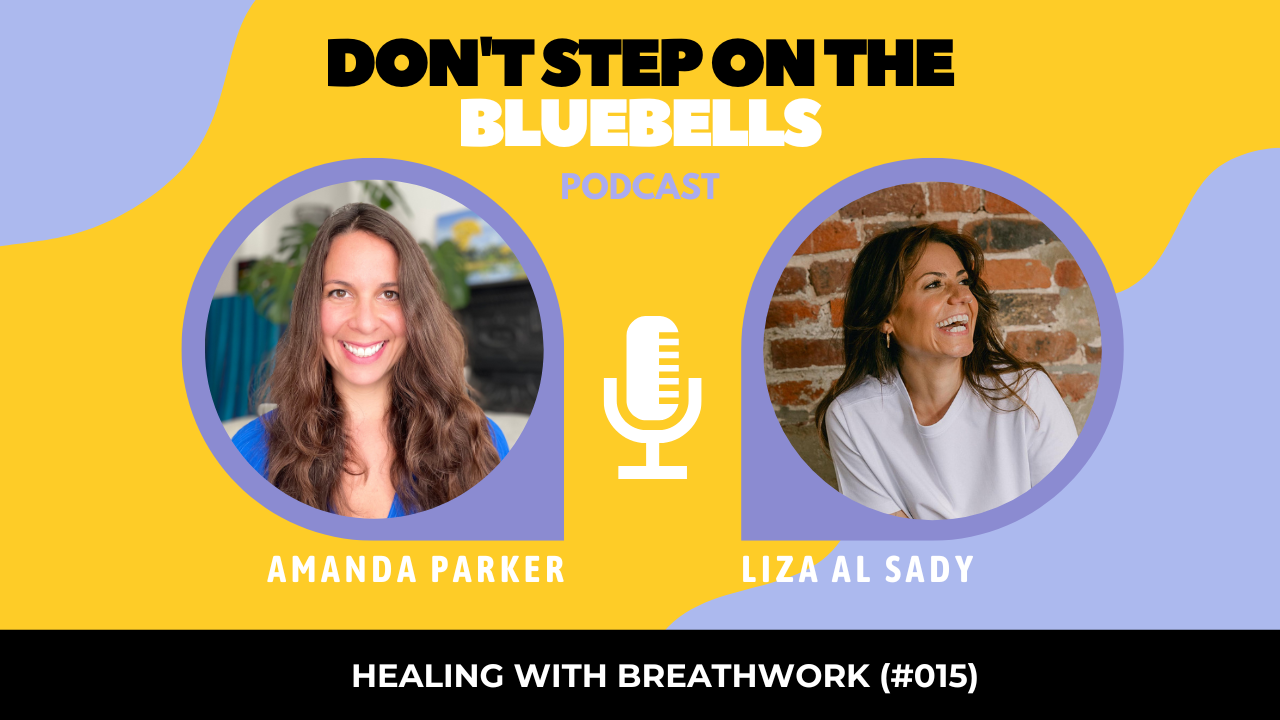
Listen to full episode
In this episode of Don't Step on the Bluebells, Amanda Parker talks with Liza Al Sady about the transformative power of breathwork for emotional release, personal growth, and healing. Liza shares her journey and how she combines conscious connected breathing with her own toolbox of healing to help people access deeper parts of themselves.
Read the full Show Notes below!
Subscribe Now
“Your mind, it will create stories and will make you think that, actually, healing is this really difficult thing, unattainable thing, and that it has to be at the right time, it has to be at the right location, but what’s harder than healing is actually living your life, carrying baggage, and carrying stuff that actually is not yours to carry.”
Today's Guest
Liza Al Sady
Hey I’m Liza Al Sady and I spent the past 15 years working in the corporate world feeling stressed, constantly chasing my next deal and overwhelmed. About 5 years ago I started looking into alternative wellness & therapies because I felt it was time that I faced my trauma head-on and committed to healing. I came to understand that no amount of avoidance could alleviate the heavy feeling I carried within me. It was like carrying emotional baggage weighing me down.
Amid my path of self-discovery and spiritual growth, I stumbled upon Breathwork, and it has profoundly changed my life. Early in 2022, I was appointed as Head of Well-being for the largest Education Recruitment Agency in the UK. I introduced breathwork and mindfulness across London and 9 regional offices, and witnessing my ‘suited and booted’ colleagues embrace breathwork for stress and anxiety management was an incredibly fulfilling moment.
This experience inspired me to create a conscious lifestyle brand, aiming to make breathwork accessible to as many businesses and people as possible. I trained in Neo Emotional Release and qualified as a Conscious Connected Breathwork Coach & Teacher under JP Crimi, a leading expert in the science and ancient wisdom of Breathwork.
My mission is to empower others with the life-changing benefits of breathwork.
Being a conscious brand isn’t about us, it’s about empowering you. At Soul Space Studio, we are committed to supporting you to lead a mindful life and giving you the tools you need to make more conscious decisions in your daily life.
How to get in touch:
Website: https://wetheconscious.studio/about
Instagram: @wetheconscious.studio
LinkedIn: https://www.linkedin.com/in/lizaalsady/

Listen to the episode on
Show Notes
In this episode of Don't Step on the Bluebells, Amanda Parker speaks with Liza Al Sady about the power of breathwork for healing. Liza explains that breathwork is an umbrella term encompassing various breathing techniques that can help relax the body, increase energy, or promote cathartic release. Liza shares her personal journey - after experiencing burnout in the corporate world, she began exploring various healing modalities and found breathwork to be a powerful tool for her own transformation.
She discusses Conscious Connected Breathwork, a specific technique involving active, cyclical breathing that helps move stagnant energy and old stories held in the body. This type of breathwork can lead to emotional release, improved sleep, and physical benefits. Liza emphasizes that the breath is wise and can guide individuals to exactly what they need in each session.
Liza's approach to breathwork incorporates additional elements such as scent, sound, and bodywork to create an immersive experience. She also touches on the similarities between breathwork and psychedelic experiences in terms of their effects on the mind and body.
Finally, Liza encourages listeners to embrace their stories unapologetically and to love and accept every version of themselves. She reminds us that while healing can be challenging, carrying emotional baggage is even harder in the long run.
Key Takeaways
Breathwork is an umbrella term for various breathing techniques that can help achieve different states within the body, such as relaxation, increased energy, or emotional release.
Conscious Connected Breathwork is a specific technique involving active, cyclical breathing (two breaths in, one breath out) that can help move stagnant energy and old stories held in the body.
Breathwork can be a powerful complementary tool to talk therapy, as it allows individuals to access and process emotions and experiences stored in the body.
During a breathwork session, people may experience various sensations, visualizations, or emotional releases. The breath is considered wise, guiding each person to what they need at that moment.
Liza's approach to breathwork incorporates elements like scent, sound, and bodywork to create an immersive, safe space for healing and transformation.
Breathwork can have effects on the mind and body similar to those of psychedelic experiences.
Healing involves accepting and loving every version of oneself, even the parts that are difficult to face. While healing can be challenging, carrying emotional baggage is ultimately harder.
Sharing personal stories without shame can inspire others to stand in their power and embrace their own journeys.
What We Talked About
How different breathing techniques can help achieve relaxation, increase energy, or promote emotional release
Liza's personal journey and how she discovered breathwork as a powerful healing modality
Conscious Connected Breathwork, a specific technique involving active, cyclical breathing
How breathwork can help move stagnant energy and old stories held in the body
The potential for emotional release, improved sleep, and physical benefits through breathwork
The wisdom of the breath in guiding individuals to what they need in each session
Liza's approach to creating immersive breathwork experiences using scent, sound, and bodywork
Similarities between breathwork and psychedelic experiences in terms of their effects on the mind and body
The importance of embracing one's story unapologetically and accepting every version of oneself
The challenges of healing and the ultimate benefits of facing emotional baggage
Guest Quotes
"Breathwork really is sort of an umbrella, I think, term to describe the different types of breathing techniques and practices that you can use to achieve different states within your body."
"The body holds onto all of the stories and the memories that you have gone through, even before you were born, when you were in the womb, that family lineage and that ancestral lineage that's linked to you, your body holds onto that, right?"
"Conscious Connected Breathwork is a three part breathing technique, right? It's two breaths in and one breath out, and we actually use the mouth throughout this experience."
"You don't know where your breath is going to take you. You set an intention, and then it takes you and shows you, because during the breathwork session you might see colors, you might see vizualisations, you might, you might meet parts or versions of yourself throughout the experience, or you might even meet, you know, people that have passed on."
"Healing is hard. You know, you're going to meet parts of you, and you're going to connect to different parts that you thought are who you are, but actually are not. And my advice is that your mind, it will create stories and will make you think that actually healing is this really difficult thing, unattainable thing, and that it has to be at the right time, it has to be at the right location, but what's harder than healing is actually living your life, carrying baggage, and carrying stuff that actually is not yours to carry."
"I always tell my clients, bring your awareness to a river, right? And imagine your body just like a river. You know, a river flows with this beautiful water that runs through, it's clear, it's glistening, it's shiny. When you're doing Conscious Connected Breathwork, your breath is taking you to those places in your body that are holding stagnant energy and are holding old stories and are holding energy that's not yours to carry."
"Catharsis is about venting, and it's about cleansing, and it's about clearing. It's an unclogging and a declogging. And so, of course, when you're moving stuff with your breath, emotional release can happen."
"Healing is about knowing more about who you are, but also the idea of being unapologetically in your story, and accepting and loving every single version of you. Even those parts that you tend to push down, the parts that you don't approve of or the old versions of you that you kind of sometimes go, 'Oh, I wish I didn't do that.'"
Resources to Learn More
We the Conscious - Liza Al Sady's breathwork studio, offering immersive breathwork experiences, workshops, and private sessions.
“Breath: The New Science of a Lost Art” by James Nestor - which discusses the importance of proper breathing techniques for overall health and well-being.
Rebirthing Breathwork: A type of breathwork that originated in the 1970s and involves a specific breathing technique to help individuals release emotional and physical tensions, often associated with the birth process.
The Hoffman Institute - A center that offers intensive therapeutic retreats, known as the Hoffman Process. The process aims to help individuals identify and release negative behavioral patterns, emotional blocks, and beliefs that may have originated in childhood. Through various techniques, including breathwork, participants work on self-awareness, forgiveness, and personal growth.
The Mandrake Hotel - A hotel in London that hosts several transformational and spiritual experiences, and where Liza Al Sady regularly hosts breathwork events
Terms & Tools to Dig Deeper
Breathwork - An umbrella term for various breathing techniques and practices used to achieve different states within the body, such as relaxation, increased energy, or emotional release.
Catharsis - The process of releasing strong or repressed emotions, often leading to a sense of relief or renewal.
Conscious Connected Breathwork - A specific breathwork technique involving active, cyclical breathing (two breaths in, one breath out) that can help move stagnant energy and old stories held in the body.
Emotional Release - The process of allowing oneself to feel and express emotions that may have been suppressed or held in the body, often leading to a sense of relief or lightness.
Healing - The process of becoming whole and healthy again, both physically and emotionally, often involving self-acceptance, processing past experiences, and releasing emotional baggage.
Immersive Experience - A type of experience designed to fully engage the senses and create a safe, supportive environment for healing and transformation.
Psychedelic Experiences - Altered states of consciousness often characterized by changes in perception, thought, and emotion, sometimes compared to the effects of breathwork on the mind and body.
Somatic Therapy - A type of therapy that focuses on the connection between the mind and the body, often involving techniques that help individuals process emotions and experiences stored in the body.
Talk Therapy - A type of therapy that involves talking with a trained therapist to process thoughts, feelings, and experiences, often with the goal of gaining insight, resolving conflicts, or improving mental health.
Thanks for listening!
What was your biggest insight from this episode? Let me know @amandaparker.co
Don't forget to support the podcast by subscribing and leaving a five-star rating.
Episode Transcript
Amanda Parker: [00:00:00] Welcome to today's episode of Don't Step on the Bluebells. I'm here with the wonderful Liza Al Sady, who's going to be sharing the world of breathwork with us and walking us through really what that is, what it means, and how her journey got her to this point where she's helping to guide others through this really remarkable process.
And also her own very unique process. So I know that there's a lot of different wonderful traditions that, uh, you have carved together to create the work that you do and I'm just so thrilled to have you here sharing that with me and sharing that with our listeners today.
Liza Al Sady: Oh, thank you so much for sort of making space for me to be here with you and to share of my practices and, uh, my journey, um, with your listeners. So thanks for having me.
Amanda Parker: Well, I am so excited. I. I [00:01:00] think I first came across your name through some events that you were hosting at the Mandrake Hotel, which is here in London. And that's how I first came to know about you, dug in very deeply to your website, to your work, and thought, wow, this is someone that I really want to speak to.
Liza Al Sady: Ah. Mm. Mm.
Amanda Parker: um, We don't have to go into the deep heart of what breathwork is straight away, but just to give people some idea, if they hear this word breathwork, what does that mean?
Liza Al Sady: Sure. breathwork really is sort of an umbrella, I think.[00:02:00]
To achieve within your body. you know, it's, there's techniques for you to use when you want to relax and chill and sort of go into the rest and digestion. And then there's other techniques that you can use to sort of bring energy into the body, you know, that three, four o'clock slump when you're like, Gosh, I need something to just give me that energy.
Then there's those breathing techniques. And then of course there's breathing techniques that go completely into the somatic and catharsis and cathartic release. And.
Amanda Parker: That helps [00:03:00] so much already. I think we've completed the interview.
Well, you do really hear so much about this word. It's become quite popular And.
it's hard to know what what that actually means and even practitioners or teachers use it in very We'll use it loosely, but meaning very different things. So I think it can sometimes be hard to grasp, like, am I using this to get into meditation?
Am I, how can I release trauma with the same thing that I can relax and meditate with? So[00:04:00]
well, it's funny because before we started recording, I like to do A bit of just A grounding. It helps me center my energy and [00:05:00] just help us to connect a bit in this space. And I always have this moment because I'm speaking with really Remarkable healers and guides and I'm like, why am I leading that? So I'm leading you through breath going Hold on a second.
Perfect. I'm here all week. Um, so if you were to take that explanation and share it with your five year old self. So you're explaining to five year old Liza what it is that you do in the world. How would you describe that?[00:06:00]
Ooh.[00:07:00]
Hmm.
There, there was a book that was published probably, I don't know, four or five years ago now by James Nestor called Breath. I'm not sure if you're familiar with the book, but he Yeah, and I, I, one thing that stood out from reading that was he did an experiment to see why, like, why do we have options to breathe through our nose or our mouth?
What's, what's the deal here? And actually sealed off his nose, like, taped it closed for a period of time, it might have been ten days or two weeks, that he could only breathe through his mouth. And shared, like, an astounding list [00:08:00] of health complications and trouble sleeping and different things that. He literally experienced in his body, just from that, short period of time, of not really getting proper breath.[00:09:00]
That's, that's really surprising, because I think most people do not think about how they breathe. Most people, like, if you start meditating, or maybe you're, I don't know, you've attended a breathwork session, but even then, most people would not really know, how am I breathing?[00:10:00]
Hmm.
It's also funny because I noticed there's this automatic reaction if you're even talking to me right now about breathing and it, it happened at an event I attended last night. Someone just mentioned [00:11:00] taking a deep breath or something about just thinking about breath. I could hear the collective room just,
mmm. So what would that look like?[00:12:00]
That is fascinating. I think there's a, I think it might be an insight. No, it might be in the app Calm, which is a meditation app that I have on my phone. And they have a few different short breathing exercises. And I think they actually do spell out for different kinds of situations what might be the best pattern of breathing.
But I never really thought about it before. I'm listening to you now. It's like, Oh, okay. So there really are thoughts about, okay, if you're in this high stress or anxiety, the best thing to do would be to breathe in through your nose And then either breathe out through your mouth or your nose, but a longer exhale than inhale.[00:13:00]
Ooh, okay. I want to know more, but I know this isn't a masterclass yet. Um, how did You start doing this work? What, what led you to this pathway?[00:14:00] [00:15:00] [00:16:00] [00:17:00] [00:18:00] [00:19:00]
I have, but maybe you can just explain it briefly because not everyone has.[00:20:00] [00:21:00]
Don't we all?
Sign me up please. You[00:22:00] [00:23:00] [00:24:00] [00:25:00] [00:26:00]
are not kidding around.[00:27:00]
This was in a recruitment role. Primarily an Ha ha ha ha ha ha ha[00:28:00] [00:29:00] [00:30:00]
Wow, that is, that is really quite a journey. And I'm sure there was a lot of just, I don't want to say hardship, but it was just, it was not an easy journey to go through. And that process of healing. while we think it's like so light and fluffy and butterflies, it's facing yourself, facing your fears, facing everything that happened in your life that You're either not happy about or that traumatized You or just so many different pieces of ourself and the healing is actually that
Ability to face all of that and come out the other side and choose your life Consciously
and what I hear from you is like there's this
Liza Al Sady: You can only meet
Amanda Parker: I mean? breathwork is your way in to help people find that for themselves [00:31:00]
So the breath. spoke to you, but it's really that, That's the platform that you can help connect people on.
Liza Al Sady: is that it creates a space for you to just gracefully meet yourself wherever you are in that journey.
And I, I love it because me, I find it as an incredible healing modality. There's, there's healing that, that goes in the body and the body holds onto all of the stories and the memories that you have gone through, even before you were born, when you were in the womb, that family lineage and that ancestral lineage that's linked to you, your body holds onto that, right?
It holds onto some of the stuff that's not even yours to carry. And sometimes we have this idea that actually sitting down and speaking to a therapist, of course it's helpful and it's beautiful and [00:32:00] I'll never say I don't want people to misunderstand what I'm going to say. What I do love is I do love the idea of using therapy to connect with your body because sometimes there's a bit of a disconnect with between the mind and the body that when we do therapy it's all about You know, what we're thinking, et cetera, and talking about emotions.
But it's very rare that have grown up learning what the vast range of emotions are. We kind of, the majority of the population probably only knows sad. happy, joy. But actually, there's a whole range of other emotions that we, we haven't been taught. And so when you speak to the, to a, to a, um, a talk therapist, for example, sometimes it's very difficult to even articulate where you want To go [00:33:00] with it.
so what I do love a lot of my clients who come to me who go to talk therapy and have been going to talk therapy for a while love this type of breathing as a beautiful compliment, right? It's a complimentary where you go, right. This is a space for me to dive into my body and to find out more about who I really am.
Amanda Parker: It's so, so many people feel tired of having to do the thought work, like having to think and [00:34:00] plan, like, I mean, I'm a person, I'm living in my head so much and I have to consciously come to my body. Things may happen and I, feel it, but I am here all the time and a lot of my clients that I work with like coaching clients, they're also there and it's literally, you're tired, you know your thoughts, you've been, with them for so long and I think it's, Yeah, I mean, you almost hear that people have been in 10 years of therapy or whatever, like it's like a badge of honor of how long you've been trying to hack it and how messed up you really are, you know?
And it's
such a relief to be able to not do that,
to just be invited to be in your body or to breathe or to just
Liza Al Sady: because she'd
Amanda Parker: experience something different.
and there's
probably a huge healing power in that alone.
Liza Al Sady: such a privilege to actually hold space for him and to watch [00:35:00] him go through something that he's been working on for quite some time with his therapist and, and having the opportunity to actually Use his breath to go deeper into the body and explore his own in the landscape. the catharsis that happened and the release that he had was so powerful and profound that he's like.
I haven't, I've been going to therapy for two years. I have not experienced this type of release. Okay. In the two years that I've been, and you know, there's something so magical with conscious connected breathwork. Um, have you tried conscious connected breathwork before? Yes. I can't wait for you. so would you like me to talk to you through what conscious connected breathwork is?
So [00:36:00] conscious connected breathwork is a three part breathing technique, right? It's two breaths in and one breath out, and we actually use the mouth throughout this experience.
Amanda Parker: No, but I uh, plan to come to a session in the very near future.
Liza Al Sady: the belly and the chest with so much air, and it's air that, because of the stress that we have on a day to day basis,
Amanda Parker: Yeah, I'd love to. I'd love to hear.
Liza Al Sady: we tend to be quite shallow breathers, right?
We don't take as much air in. sort of in our upper chest. But when you take the time to actually go into this beautiful cycle of breath, Um, and I sort of do it in a, in a specific way. I go around to every single person to make sure they are going deep into the belly, but it's an active breath, right?
It's not like a, that's the, the, the work. the breathwork, that's what the work is and it's active and it's full and it's the [00:37:00] cycle and it's continuous. And when that happens, things shift in the body and so many people go, Oh my gosh, I cannot believe this just happened by me changing my breath. And, um, you know, you're going deep into the body, right?
You're connecting with all of your chakras. You're, you're shaking things up. I always tell my clients of, you know, You bring your awareness to a river, right? And imagine your body just like a river. You know, a river flows with this beautiful water that runs through, it's clear, it's glistening, it's shiny.
You know, it's gently going down the stream, right? It's beautiful river along the way. Okay. Weather changes, seasons change, and you'll find a lot of debris that starts going into that river. You get rocks, you get pebbles, there's branches, there's [00:38:00] leaves. Someone might come in and jump into, you know, the river and, you know, so it becomes murky, that water that was once glistening and clear becomes murky.
And what. to happen, Mother Earth brings in a storm, right? in a storm to shake this river up, right? To move some of this stuff that has created blockages for the water to go through. And then after that storm, water comes back in and it's nice and it's clear and it's crystal, etc. I always say, think of your breath exactly like that water.
When you're doing Conscious Connected Breathwork, your breath is taking you to those places in your body that are holding stagnant energy and are holding old stories and are holding energy that's not yours to carry. And so when you go through that, things are going to happen, things are [00:39:00] going to shift.
And catharsis will happen. That's the whole idea of Conscious Connected Breathwork, that it promotes catharsis. catharsis is about venting, and it's about cleansing, and it's about clearing. It's an unclogging and a declogging. And so, of course, when you're moving stuff with your breath, Emotional release can happen sometimes, I know that there's a lot of stuff at the moment on the internet about how we should not call conscious connected breathwork, breathwork for emotional release and stuff like that.
And I just wanted to clarify what I mean, what my definition is about emotional release. emotional release, you know, is not about just releasing crying. You know, with the method that I use, there's a lot of sounding, there's a lot of releasing, um, and anger through some of the stuff that we do, also [00:40:00] emotional release could also be the idea that you're having a chesty cough, which happened with one of my clients, you had a chesty cough, she couldn't move it.
For, she couldn't shake it for four weeks. She came to one of my sessions two weeks ago. Then she sent me a message the day after. And she's like, Lisa, you will not believe I woke up and hand on heart. I do not, it's so much better at 70 percent better. And for me, that is the emotional release. That is the bit where your breath is going and shaking stuff up within your body.
And that is the release, right? It doesn't have to be there at the same time where you might have Cry. A lot of people cry. There's tremoring happening, etc. Depending on your body, right? Whether you have a, a, an experience where you're releasing crying emotions or whether you don't, doesn't mean that stuff is not happening within your body.
You know, catharsis could be that you actually, [00:41:00] Go home and have a great sleep and the day after you have incredible bowel movements because you've been so stressed and you've been holding your tension in your body. And for me, that is emotional release, right? That is what a release of emotion is. And that's why I just call this modality the wise one.
It's so wise, because Amanda, you don't know where your breath is going to take you. You set an intention, and then it takes you and shows you, because during the breathwork session you might see colours, you might see visualisations, you might, you might meet parts or versions of yourself throughout the experience, or you might even meet, know, people that have passed on.
That you never know what happens throughout this experience. And so every single time it's different and that's what makes it so profound.[00:42:00]
Amanda Parker: Well, that touches on a lot of what I'm also extremely interested in. I mean, I'm, I'm already too far down that pathway to pretend otherwise, but like the mystical element as well, that.
Liza Al Sady: It
Amanda Parker: know, there is this physical release you're really connecting in, and it's possible for there to be mystical experiences.
Not that everyone will have it, and not that it's a guarantee, but
that that could actually be a door opener to something that you never even imagined possible in a different realm.
Liza Al Sady: okay, and, using bodywork
Amanda Parker: You can tell that's, that's [00:43:00] where my interest. I'm like, Ooh, I can have mystical experiences too.
Liza Al Sady: might sense that your shoulder is tight. I might help you with your shoulder or your hip. I might touch you somewhere that will really help move some of that stagnant energy. Psychosomatic, are words that I say and phrases that I say throughout the experience.
And when you're in the breath, you, you're not really going to hear everything, but you're going to hear what you need to hear. What's resonating with you. There's a lot of talk about shame and guilt and, um, you know, Energies and what you're holding onto and the grip of control. And that changes depending on the intention of what the session is about.
Um, the music that I play, uh, is all part of it. You know, some people go, a bitch. You created this playlist for us to cry. And I'm like, listen, I'm guilty, it is my toxic trait. [00:44:00] I enjoy holding space. Yeah, like that is my thing. Sorry, but it is my toxic crate. I enjoy, I enjoy people releasing. Right.
Because I feel that we're in a society where expectation is so high, you know, expectation is so high. And we put so much pressure on ourselves and
Amanda Parker: I want you to cry.
Liza Al Sady: you know, we've got this idea that we have to be strong all the time. You know, you go into a workplace and you can't show emotion and you suppress it.
Like, you know, when you say. Gosh, you know, I had like a lump in my throat and then I had to swallow it, you know, all of those stuff that actually accumulate in the body. And I know that from my own experience is that when I lay down to breathe, a lot of that shifts, I can release a lot of that by just focusing on the [00:45:00] breath.
And part of the, the soul space method is I use, uh, scent. I use specific scent depending on, um, what intention or what we want to release or where we want to go in. Um, and I use sound of course, and it's a closed eye experience. You know, there's an eye mask because when you don't have that distraction from the mind, That goes, Oh, go on, open your eyes.
See what's happening. Who's crying. Who's not what's going on. You kind of surrender a little bit more to the experience. even though conscious connected breathwork is actually great because it shuts off the inner critic. It shuts off that ego. It dampens that part of your, of your mind. Um, but that is my passion.
My passion is mixing modalities together. To allow the body to completely surrender to the experience. And so all of my sessions are created to [00:46:00] be immersive. sessions from the moment you open the door. It's not from the moment you lay on the mat, but for me, it's sort of like, can I make every single person who steps in through the door to feel safe, to allow their nervous system to go, okay, this is a safe space.
I can just be before laying on the mat. And so everything is completely planned and taken care of. So the sound to the scent, to the lighting, to the words that I say, it's all preparing you for that moment when you lay on the mat. And so mixing modalities for me is so important. So one of the things that I do, I do the blending.
breath and hammock. So it's sort of like we do conscious connected breath work. We breathe, we do the whole thing. And then for the rest period you jump into a floating hammock, um, to, to [00:47:00] reset. And of course, you know, it's completely immersive. The light, the sound, everything is incredible. I had a session about a month ago.
And it was really interesting because I used specific frequencies, um, during the, the hammock session, um, and I think the session was about radical self love. So a lot of the frequencies that I used during the session was all about, you know, love, negative energy, et cetera. we had a sharing circle at the end of it.
And it was so profound because it was one of those sessions where half of the class, half of the people who were there had the visualization, mystical kind of stuff. And I'm like, hold up, you know, somebody saw a whale and somebody saw like this horse that was guiding them towards somewhere and somebody else saw, and then someone else was like, I didn't see [00:48:00] any of that.
that's okay, right? Because every single time you're going to have a completely different experience. And that's what's so magical about it.
Yeah,
Amanda Parker: Well, it sounds almost how people might describe.
like plant medicine, where you go into an experience with an open mind and you have no idea
what will happen. You might have an intention, you might have a
Liza Al Sady: take psychedelics.
Amanda Parker: something that you want to solve, but you'll get exactly what you need.
That [00:49:00] you might not know what that is, but that you will receive it and have the opportunity to really experience and pass that.
Liza Al Sady: they wanted to see the effects of conscious connected breath work on the body, and they found that Actually, there were so many similarities between going on a psychedelic trip going through conscious connected breath work for a prolonged period of time and the effect it had on the body and the mind.
And for me, that is profound because, you know, some of my clients who go into, you know, they do, they're like, Oh my gosh, I feel like I've just had an ecstasy pill. What happened there? And that's the, that's the, the magic, right? The magic is the yourself to just surrender that surrendering of, you know, uh, [00:50:00] part is going to be hard, some of it is going to be scary, however, I'm going to go through this, and I'm going to do it one breath at a time, I'm going to see what's waiting for me on the other side.
Amanda Parker: Yeah.
Liza Al Sady: Yeah, look, there's so, there's so, there's so much out there, because, you know, breathwork, mean, conscious connected breathwork started really in the 70s,
Amanda Parker: if people are listening And, they really want to
learn more about,
well, specifically conscious connected breathwork or just how breathwork might serve them. Are there like books or podcasts or the resources [00:51:00] you might recommend someone to begin
to learn?
Liza Al Sady: And he started doing this, uh, breathing and, uh, a guru from India came to him in a visualization and basically told him that he had to take this breathwork and expand it and rebirthing, rebirthing Breathwork to fruition and there's so much literature out there that you can go and you know, you can read about, you know, if you're looking at the traditional sort of functional breathing, of course, James Nesta, but then, you know, the internet is peppered with delicious breathwork stuff.
And, um, and. It just, you know, if you want to learn more about conscious connective breath work, I'll probably say rebirthing, uh, because that's where it kind of stemmed from. and that's why this type of modality is not really, um, [00:52:00] advisable for anyone who's pregnant. unless you want to go into labor!
You're like, we need to get the baby out, let's not do breath work until you,
yeah, exactly, exactly. Sure,
so, you can head to, um, www.
Amanda Parker: Okay.
Liza Al Sady: Uh, studio. com got all the events there. I've got all, you know, there's a lot of, um,
Amanda Parker: Maybe, maybe people will start that then.
Liza Al Sady: conscious, connected breath work, and also private
Amanda Parker: how can people find you if they want to have a session with you?
What does that look like?
Liza Al Sady: and, um, a, a, a space for connection, uh, deeper, deeper, profound connection. Um, and all of the events are [00:53:00] there as well. Um, they would like to see some of the immersive stuff that I do, then, uh, Instagram would be the best place, which is soul space dot studio. Um, and if they want to chat, then they can send me an email.
Uh, yeah, hello at soul space hyphen studio. com.
Oh, thank you.
Oh, I cannot wait to hold sacred space for you. So yeah,
Amanda Parker: Perfect.
Liza Al Sady: I look forward for you to, to join any of my
Amanda Parker: Great. I'm gonna connect all of those in the show notes and tell people exactly where They can go. But I know you do some really amazing [00:54:00] events and just, I've seen a lot of it and
I'm really excited to experience one, but it's really, really beautiful.
Liza Al Sady: of love from me to them to hopefully come and experience, um, a session.
Yeah, exactly. Get yourself here, guys. Get yourself ASAP. Yeah,
yes, it will be an experience here in London. I do, I do some online stuff and there is a capacity to actually book online for some of my, you
Amanda Parker: Wow, that is extremely generous. Listeners, you do not want to miss this.
Liza Al Sady: is a profound experience if you're, if you're used to doing somatic
Amanda Parker: just to check, you do mostly in person, right? So it would be an experience here in London. [00:55:00]
Liza Al Sady: Yeah. Yes. Yes. I'm like, I just want to be there. You know, I just want to make sure that I'm really holding space, you know, holding your hand. If you need me to hold your hand.
Amanda Parker: Yes. I understand That A lot of us have gotten too comfortable behind our screens.
Liza Al Sady: That actually. You know, starting something, doing something that process of it and
Amanda Parker: So is there any last advice that you would give to someone who's thinking of starting this path or they're just
curious? What would you tell them? What would you wish to have known?
Liza Al Sady: more about who you are, but [00:56:00] also the idea of being unapologetically in your story, um, and accepting and loving every single version of you.
Even those parts that you tend to push down, know, the parts that you don't approve of or the old versions of you that you kind of sometimes go, Oh, I wish I didn't do that. It's about loving and accepting every single part of you. And, you know, healing is hard. You know, you're going to meet. Parts of you, and you're going to connect to different parts that thought are who you are, but actually are not.
Uh, and my advice is that your mind, it will create stories and will make you think that actually healing is this really difficult thing, [00:57:00] unattainable thing, and that to be at the right time, it has to be at the right location, but what's harder than healing is actually living your life, carrying baggage, and carrying stuff that actually is You can process and learn from and lean on and will make your life so much easier.
Thank you.[00:58:00]
Amanda Parker: Those are beautiful parting words. So, Liza, Thank you.
so much for sharing.
really beautiful stories. you are a wonderful storyteller and sharing so generously
this whole process and your own story how you got here. So I think that's
gonna really resonate for a lot of people who
want change and are hungry for it and just don't know where to begin.
Liza Al Sady: Um, and
Amanda Parker: So I really appreciate you being here, sharing with all of us, and
Liza Al Sady: I go deeper
Amanda Parker: I can't wait to get this episode out into the world.
Liza Al Sady: to me.
and the reason I do that is because. I want to give that little girl inside me the voice that she never had, you know, and I want her to know that it was never her fault. And, you know, she's grown up to be, an amazing woman. And I [00:59:00] really hope by me doing that, it inspires other people to stand their power and within their story and to actually talk about their story without any shame.
And so thank you for giving me that, that space today.
Amanda Parker: Thank you so much and thanks to everyone who's been listening and on this journey with us. So thanks for tuning in to Don't Step on the Bluebells and see you next time.[01:00:00]