#071 Dr. Mandy Lehto on Why You Never Feel Like Enough
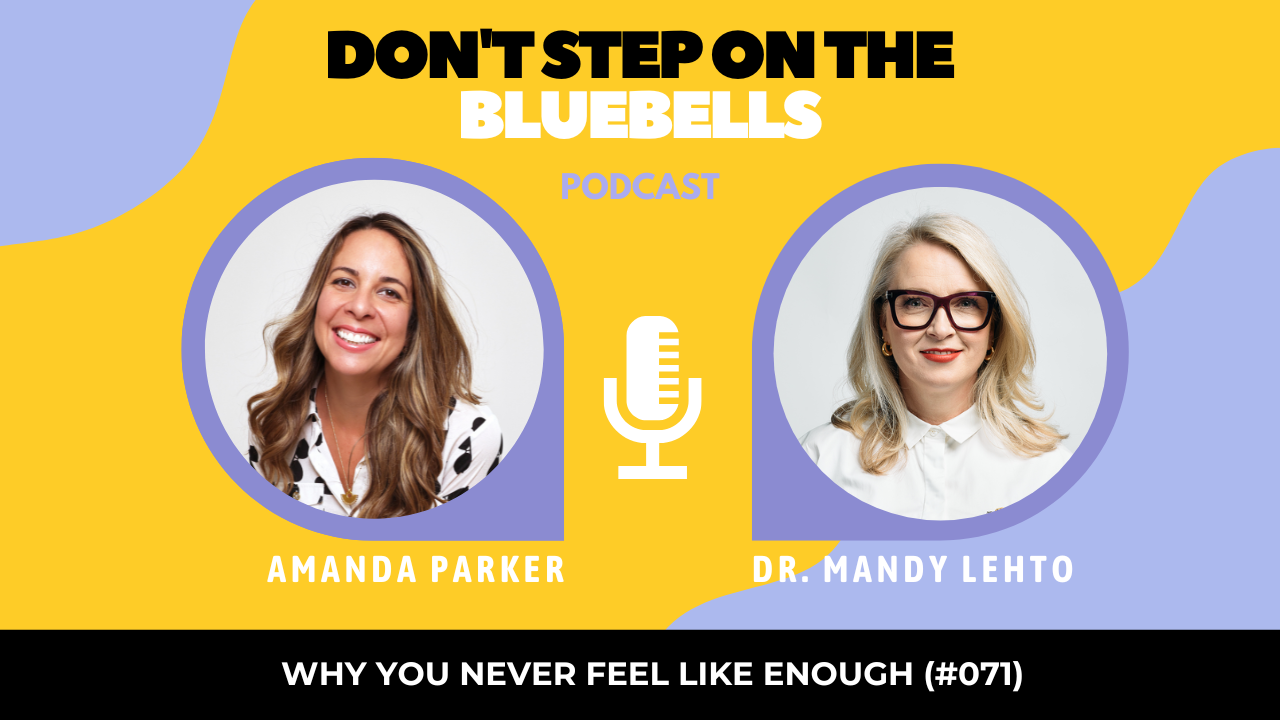
Listen to full episode
Dr. Mandy Lehto on why "enough" is a target you can never reach by achieving more — and how burnout, grief, and radical self-compassion taught her a completely different way to live.
Read the full Show Notes below!
Subscribe Now
“I define wholeness as the whole mess, which includes our felt sense of not being enough. That’s part of being whole, is forgetting that you’re whole.”
Today's Guest
Dr. Mandy Lehto
Dr. Mandy Lehto is an executive coach, writer, and host of the top-ranked Enough the Podcast — a show for people whose lives look shiny and successful on the outside, but who never feel quite good enough. She holds a doctorate from Cambridge University and is a former Director in Fixed Income sales at a German investment bank. With over 15 years of coaching experience, Mandy works with Managing Partners, C-suite executives, and senior leaders, and her insights have been featured in Forbes, The Times, Fast Company, Psychology Today, The Huffington Post, and on CNBC. A recovering overachiever who spent much of her forties navigating debilitating burnout, Mandy now helps high achievers redefine success and recognize their inherent worth — without the achievements.
How to get in touch:
Website: https://mandylehto.com/
Instagram: https://www.instagram.com/mandylehto/

Listen to the episode on
Show Notes
What if the thing you've been chasing your whole life — the promotion, the book deal, the perfectly executed healing journey — was never going to make you feel enough? Dr. Mandy Lehto spent most of her forties crashed out in burnout, forced into a reckoning with everything she'd been trying to outrun. In this profound and often funny conversation, she shares what she found on the other side: not a 10-step plan, but a completely different relationship with worth, rest, and what it means to be whole.
Mandy defines enoughness as the felt sense of our worth — something that comes and goes like weather — and exposes the "insidious" pursuit of more that keeps high achievers on a hedonic treadmill she calls "nexting." She's disarmingly honest about her own attempts to win at healing: flying 12 hours to sit with an elite coach in Arizona, executing nutrition plans with A-star perfection, collecting retreats and modalities — only to be told, "Nobody is coming to save you, Mandy."
The conversation deepens into the territory most of us avoid: why rest feels like falling behind, why high achievers can endure enormous productive discomfort but crumble in the unproductive kind, and how sitting with her dying mother stripped purpose down to something as small — and as big as the universe — as kindness and compassion.
Whether you're a healer, a coach, or a recovering overachiever, this episode will hold up a mirror. And it just might give you permission to stop running.
Key Takeaways
Enoughness is the felt sense of your worth — and your worth is constant, even when the feeling isn't.
"Enough" is a moving target: no achievement, purchase, or milestone will ever make you feel different.
Feeling not-enough doesn't mean you are not enough — "I feel like this" does not equal "I am this."
Feeling not-enough is part of being whole, not a sign something's wrong with you.
You can't achieve your way out of not-enoughness — not even by achieving at healing.
High achievers can endure enormous productive discomfort but avoid the unproductive kind: sitting still, reflecting, not knowing.
Rest feels like falling behind because achievement is the only compulsion society applauds.
Nobody is coming to save you — the expert you keep searching for is you.
Ask yourself: what would that goal give you that you don't already have?
At the end of a life, kindness and compassion are what remain — and they turn out to be enough.
What We Talked About
What "enoughness" actually means — and why almost nobody can define what "enough" would be
The hedonic treadmill and "nexting": chasing the thing that never changes how you feel
Mandy's burnout in her forties — the reckoning that came when she could no longer run
"I do, therefore I am": what happens to identity when achieving is taken away
Why rest feels like falling behind — and the pride high achievers take in overriding it
Trying to excel at healing: Arizona coaches, crystal recipes, tantric retreats, and being told nobody is coming to save you
Healing as seasons: darkness, nothingness, snow in April, and meeting yourself where you are
The parallel between burnout recovery and spiritual awakening — when the ground disappears beneath you
What sitting in hospice with her mother taught Mandy about purpose, accumulation, and what's actually enough
The "green room" of your life: the patient desires waiting to be called on stage — and the "I just have to" lie that keeps them waiting
Guest Quotes
"More is often the answer. And I think that's what makes the pursuit of enough so insidious because it's a constantly moving target. It's a mirage shimmering on the horizon."
"I think this is the thing that many people are searching for without being able to name it. If I were enough, I would feel different."
"The working definition I have for enoughness is the felt sense of our worth. Our worth is always there from the time we show up on this planet."
"I define wholeness as the whole mess, which includes our felt sense of not being enough. That's part of being whole, is forgetting that you're whole."
"I am not a guru in white robes on a mountainside. I am right here with all of you trying to figure this out. I just think about this a disproportionate amount of the time."
"I had this mantra, like I do, therefore I am. And when I could no longer do, it was like, well, what's even the point of me?"
"One of my absolutely favorite coaching questions: what are you trying not to know?"
"I was somehow hoping to excel at healing. Because I wanted something to distract my attention from sitting in the boredom of meeting myself where I was."
"It's the only compulsion that is publicly applauded. Like if you were doing that with cocaine or gambling or sex or shopping, nobody would applaud that."
"I feel like this does not equal I am this. That is what I have found when I have allowed myself."
"We give plants and nature slack that we don't give ourselves."
"What positive habits or desires are patiently sitting in the green room of your life, waiting to be called on stage?"
"It turns out that kindness and love and compassion are enough. And it sounds so small, but actually it is as big as the universe."
"I have expertise, but the expert is you. And the whole point is you're not supposed to know what to do."
Resources to Learn More
Enough the Podcast — Mandy Lehto's podcast, for people whose lives look shiny and successful on the outside but who never feel quite good enough - https://mandylehto.com/enough-the-podcast/
Terms & Tools to Dig Deeper
Adaptive vs. maladaptive achievement — Mandy's framing of achieving as a spectrum: healthy and fun at one end, but there's a tipping point where the same drive starts working against you — like taking pride in overriding your body's need for rest.
Burnout — A state of complete physical, mental, and emotional exhaustion caused by prolonged stress and overwork, often leaving even small tasks feeling impossible.
Duress cleaning — Clearing out a loved one's home under time pressure, often during illness or after death; a confronting encounter with a lifetime of accumulated possessions.
Discombobulation — Mandy's signature word for the disoriented, ground-gone state of not knowing who you are or what comes next. Building the capacity to stay in discombobulation — rather than escaping into action — is central to her whole approach.
Ego death — The dissolution of the identity you've built around who you think you have to be, often triggered by crisis, which makes space for something truer to emerge.
Enoughness — Mandy's term for the felt sense of our worth. Worth is constant; our felt sense of it comes and goes.
Hedonic treadmill — The psychological pattern of achieving a goal, feeling briefly satisfied, then returning to baseline and chasing the next thing.
Integration — The inner work of sitting with and absorbing an experience or insight so it actually changes you, rather than rushing to the next healing experience.
Kundalini awakening — A spiritual awakening experience, often described as a powerful rising of energy through the body, sometimes sought through practices like breathwork.
Nexting — Mandy's term for the constant pursuit of the next thing we believe will complete us or finally make us feel enough.
Non-sleep deep rest (NSDR) — A guided restful practice (lying down, deeply relaxing without sleeping) used to restore energy and calm the nervous system.
Reflexology — A healing practice applying pressure to points on the feet, hands, or ears believed to correspond to other parts of the body.
Reiki — A Japanese energy healing practice in which a practitioner channels universal life-force energy through their hands to support relaxation and healing.
Self-compassion — Treating yourself with the same kindness you'd offer a friend, especially in failure or discomfort. Mandy tells the story of trying to become "the best self-compassion meditator" — turning even kindness into a competition.
Shamanism — An ancient spiritual practice of connecting with the spirit world and energy of nature for healing and guidance.
Spiritual awakening — A profound shift in consciousness and identity, often involving the dismantling of who you thought you were. Amanda draws the parallel between Mandy's burnout journey and awakening: the ground disappears, and you can never go back to who you were before.
Wholeness — Defined by Mandy as "the whole mess" — including the parts of us that feel not enough. Forgetting you're whole is part of being whole.
Thanks for listening!
What was your biggest insight from this episode? Let me know @amandaparker.co
Don't forget to support the podcast by subscribing and leaving a five-star rating.
Episode Transcript
Mandy Lehto: [00:00:00] Just more is often the answer, and I think that's what makes the pursuit of enough so insidious because it's a constantly moving target. It's a mirage shimmering on the horizon that when we think we accumulate enough, or when we think we achieve enough, or when we give enough, or, you know, when we push our own needs down enough, we will arrive at some fictional location
Amanda Parker: Welcome to Don't Step on the Bluebells, the podcast where personal healing and transformation take center stage. I'm your host, Amanda Parker, and I'm a fellow seeker on the journey of personal growth. Join me as I delve into the stories of gifted healers, guides, and everyday people who have experienced remarkable transformations.
Amanda Parker: Listen in as they share their practical wisdom to enrich your everyday life. And don't forget to hit subscribe and never miss a new episode [00:01:00] Welcome to today's episode of Don't Step on the Bluebells. I'm your host, Amanda Parker, and today we're talking about something almost everyone feels but nobody seems to be able to name: why you never feel like enough.
Amanda Parker: My guest is the incredible Dr. Mandy Leto, executive coach, podcast host, and writer. Mandy holds a doctorate from Cambridge. She's the former director of fixed income sales at a German investment bank. With over 15 years experience as an executive coach to managing partners and C-suite execs, with features in Forbes, The Times, and Psychology Today, she checked every box of success.
Amanda Parker: That is, until burnout took her out in her 40s. What she found on the other side is what she now brings to her top-ranked show, Enough: The Podcast, and to this conversation. On this episode, we discuss why enough feels like a target that keeps on moving no matter what you achieve, what it means to [00:02:00] try to win at healing, and why that keeps you stuck even if you're doing all the retreats, the courses, and certificates.
Amanda Parker: Oh, and she calls herself an emotional Land Rover. You're gonna wanna hear why. So without further ado, let's dive in. Today we really wanna dive into this topic. I mean, it is one of the core things that you speak about. So it's this feeling of enoughness. And for those who are listening who haven't yet discovered Mandy's work, um, she has a podcast called Enough, so definitely go dive in and check out those episodes.
Amanda Parker: But it's really a topic that I would say I have struggled with so much in my own life, the people that I work with and support struggle with, but most people can't actually name what that is. So could you tell us a bit like what does it mean to be enough, or what is enoughness?
Mandy Lehto: I think this is the conundrum of [00:03:00] enough, is that it's undefined a lot of the time.
Mandy Lehto: And when I ask somebody that question point blank, "What would be enough? How much would be enough money? How mu- how many shoes would you need? How many letters would you need behind your name?" And often there's this bunny in the headlights look of discombobulation, and it's just like, "I don't know, more.
Mandy Lehto: Just more. Just more." is often the answer. And I think that's what makes the pursuit of enough so insidious because it's a constantly moving target. It's a mirage shimmering on the horizon that when we think we accumulate enough or when we think we achieve enough or when we give enough or, you know, when we push our own needs down enough, then we will arrive at some fictional location, and we will feel different.
Mandy Lehto: And I think this is the thing [00:04:00] that many people are searching for without being able to name it. If I were enough, I would feel different. And that always makes me a little bit curious because really the, the working definition I have for enoughness is the felt sense of our worth Our worth is always there.
Mandy Lehto: From the time we show up on this planet and beyond is anybody's guess, but I'm hoping it, it comes with us. So worth is a constant. Our s- perceived notion of it isn't. Sometimes when we see someone doing better than us, we go down this downward spiral. Somebody got a book deal, and you're really desperately trying to get one.
Mandy Lehto: Somebody got a partner, and you're single and hoping to have. Somebody had a new kitchen renovation, and yours is that kind of avocado color from the 1970s. So like, all of these things, comparison can be one thing. That can be [00:05:00] one way of tripping us into feeling not enough. There's other ways. Somebody gets what we want, and all of a sudden we start telling ourselves a story that I'm not enough because we have a, an uncomfortable feeling, and therefore it can kick off all these dominoes of I suck, I'm never gonna get what I want, uh, and rah, rah, rah.
Mandy Lehto: And it just is-- doesn't feel good to be there. But enoughness, that felt sense of our worth, comes and it goes, because three m- three days later, you might feel on top of the world for whatever reason. So I think about enoughness as weather. It comes and it goes, and it's part of wholeness because I define wholeness as the whole mess, which includes our felt sense of not being enough.
Mandy Lehto: That's part of being whole, is forgetting that you're whole. So that's how I would define it and why it can be, we can be in [00:06:00] such tricky relationship with it, because it's a moving target that is never defined. That whole hedonic treadmill, you know, you think you want the thing, you achieve the thing, and you think, "Oh, I didn't-- it didn't change me the way that I thought, so it must be the next thing, and the next thing."
Mandy Lehto: That, what I call nexting, that constant pursuit of what we think will complete us or make us feel a certain way, that's the insidious bit of it. It's exhausting.
Amanda Parker: Wow, that's already gonna, like, hit the nail on the head for so many people who are listening. I'm curious if you think this is something that you ever age out of.
Amanda Parker: Is this something that you have your whole life, or is it, like, you know, just for young people, or do we reach an age, you know? There I am again- Well,
Mandy Lehto: I'll let you know when I get there ... with that hedonic wheel. Yeah, I'll let you know when we get there. Um, my feeling is that it's something that we-- it's part of the human condition.
Mandy Lehto: I'm willing to be proven wrong at some stage if I cross some kind of threshold. Like, I will come back for a episode, [00:07:00] another episode of this podcast and and tell you I've changed my mind. But the whole point is, what if it wasn't something bad to feel not enough? What if it's just something we expect?
Mandy Lehto: It's like we can't expect to have sunny days all the time or rainy days all the time. What if it's just something that if we can make peace with there will be times where I'll feel like I suck? But the operative word here is I feel like I suck, and it can be so easy to distort that when you're in that downward spiral or when you're sitting there in your emotional mucky diaper.
Mandy Lehto: It can be so easy to translate that into I suck So I think that we get better at catching that distinction. Like, I feel like this at the moment. It doesn't mean I am this. So I think that's where we start to improve at noticing, and we also build our capacity to be in the discomfort of not enoughness, [00:08:00] 'cause it's just part of wholeness.
Amanda Parker: Your work on this and the way that you speak about it, it's so clear. Like, I know that you're an expert, but how did you come to even identify this yourself? Was there a moment in time where you just realized, "Oh my God, I always feel like I'm not enough"?
Mandy Lehto: Uh, how long do you have?
Amanda Parker: Yeah. We, we g- as long as you want.
Mandy Lehto: I think it really hit home for me when I spent most of my 40s crashed out in a burnout. Burnout is a really... It, it's a useful tool in some ways. It's a useful state to be in, because one of the things that people who are constantly pursuing enoughness and trying to move towards the mirage shimmering on the horizon and simultaneously move away from the feeling nipping at your heels of, "I'm ordinary, I'm not special, I'm inadequate, I'm gonna be irrelevant."
Mandy Lehto: So it's a moving towards and a moving away from at the same [00:09:00] time, so there's that, that tension that's happening there. And when you can't be in movement towards and/or away from something, and you're taken out like I was with my burnout, there's a lot of time to think. Because sometimes even talking or reading a book or listening to music when you're, like, really in a bad burnout feels like it expends too much energy.
Mandy Lehto: So I ended up spending a lot of time in the tumble dryer of my own thoughts, which sucked basically, because achievement and doing and being in constant activity is a way that we can outrun those beliefs and thoughts, "I'm not enough. I need to get away from this feeling." And the thing is, because burnout took my knees out from under me, I could no longer run, and I had to have a kind of reckoning with myself, and there was kind of an ego death, I suppose.
Mandy Lehto: Um, and it's not [00:10:00] to say that new ones don't develop. Like, I'm not saying by any means, I really wanna make this crystal clear to anybody listening, I am not a guru in white robes on a mountainside. I am right here with all of you trying to figure this out. I just think about this a disproportionate amount of the time.
Mandy Lehto: Yeah. So I have some ideas. I have some experiments. I have some thoughts But I would even push back on I'm an expert. I have expertise in this, but everybody's journey will be unique. So really what brought this to a head for me was when I had to stop, and it wasn't my choice. It was forced on me, and all of a sudden I had to reckon with all those things that I had been trying not to know.
Mandy Lehto: One of my absolutely favorite coaching questions, what are you trying not to know? And sometimes when you have to sit with yourself, that's actually where I did my reps of learning that I could hold a lot more discomfort [00:11:00] than I thought. Childbirth was easier in some ways than sitting with myself unable to achieve.
Mandy Lehto: 'Cause I had this mantra, like, I do, therefore I am. And when I could no longer do, it was like, well, what's even the point of me?
Amanda Parker: That's definitely very resonant, that feeling of wanting to continually reach towards the next thing and the next thing, always hoping that that next thing is gonna be the thing that finally ends the cycle of trying to get there
Amanda Parker: And having to sit in that space of, yeah, feeling your feelings, which is what all of that achievement is just nicely covering over. I find myself in these cycles so often, you know, that I, I really will understand that very clearly. Oh, no, now is the time to rest, but there's, like, this, you know, a little bit of an ADHD brain, undiagnosed, but there's, like, a little bit of that going on for me that it's like, ooh, but look at [00:12:00] this shiny new exciting project that I could be working on.
Amanda Parker: I think I'm gonna get a lot of satisfaction out of bringing that to life . So there's definitely this element of, um, yeah, wanting to... It's not even just achieve, because I dress it up as wanting to create. So create something new. And sometimes it is, and sometimes it's just that until it needs to become something more
Mandy Lehto: Yeah. I, I think there's nothing wrong with achieving. Like, there's a, it's, it's healthy. It's, it's fun. It's exciting. And I think that's why it can be so difficult to look at this and think, well, does it mean I'm supposed to not achieve and I'm just gonna sit on the sofa in track pants, like, watching daytime television?
Mandy Lehto: Like, I, it can f- be so mind-bending. But I think it comes back to what you said about rest. And I think so many of the people who I work with who are high achievers bordering on overachievers [00:13:00] is, I like to think about it like a spectrum. Achieving is a great thing, but there's a point when something that's adaptive becomes maladaptive And there's bringing curiosity to that.
Mandy Lehto: Often, and I can only speak for myself, but I see this pattern in a lot of my high-achieving clients too, is that rest is something that there, there can almost be like a pride in overriding the need to rest. Like somehow that's the secret formula, that's the secret extra battery pack that allows you to leapfrog over others.
Mandy Lehto: There's this desire to escape mediocrity, the desire to escape irrelevance, that desire to be special, the desire to win because accolades, status, shiny things bestow some kind of immunity or status on you from all of the things that I said are nipping at your heels. And therefore, to rest means that you're [00:14:00] not outrunning the things nipping at your heels anymore, and that there can be a fear of irrelevance, a fear of mediocrity, a feel of being, heaven forbid, ordinary.
Mandy Lehto: So rest is a very complicated thing. Like it can feel like falling behind. I saw you had Matt, my friend Matt Chavlovich on the show, and he said one thing once that I'll never forget. He said, "As an athlete, rest day is a training day." And I think there's something about being able to intellectually understand that, but the tipping point into maladaptivity, and I don't wanna make this pathological, so I'm, I'm trying to be mindful of the language that I'm using, is just bringing curiosity to where am I overriding my body's need for rest, and what am I thinking that that extra output will give me that I don't already have?
Amanda Parker: That is powerful. So everyone listening, take that. Ask [00:15:00] yourself that really, because I know, um, that's definitely the type of listeners that we have. This podcast is really all about, like, healing and personal transformation, but a lot of the listeners are healers, and so we hear these words of, like, high achievement, and you almost don't think that it applies in the healing space because people are looking to support others and heal them.
Amanda Parker: But the truth is, it's just another avenue, another way to grow, another way to kind of shape yourself into something. Do you see any link between this concept of, like, not feeling like enough or that you need to continually achieve and what's, what I'm seeing in, like, the healing space and the personal growth space, that it's a never-ending journey of healing?
Amanda Parker: Like, people are continually seeking out those experiences that will heal them.
Mandy Lehto: I can 100% put my hand up on this and say guilty as [00:16:00] charged, because it was another way of achieving healing, hacking healing, right? So when I was in my burnout, and by the time I started to feel a little bit better, it was the same thing.
Mandy Lehto: Like, I can look at that Mandy with such compassion now because it was like, "Right, I'm gonna hire the best coach, so I'm gonna fly 12 hours to Arizona and sit in the presence of this coach." And when I got there, he's like, "Nobody's coming to save you, Mandy." I was like, "Oh shit, I could've saved all that money if you would've just told me that in the email."
Mandy Lehto: And I was looking for somebody to give me the formula so that I could go and execute it perfectly. So I got a plan from a nutritional therapist. I executed it with absolute A-star perfection, and I still wasn't healed, so I must need Reiki healing and reflexio- reflexology. I must need to go to a tantric practitioner.
Mandy Lehto: I must need to go to the Wild Woman Retreat. I must need to go to Sedona and sit on a mountainside. I must need a crystal recipe from someone. I must need [00:17:00] all... Like, I could go on and on and on and on. I spoke to my lady parts Right? I, you know, danced naked with a series of women. We laid hands on each other.
Mandy Lehto: We did all the things like healing and all the... And I'm still frustrated at that stage because I'm like, "Why is it not working? I'm doing all the things. Why is it not working? I must need a better tantric practitioner, a better coach. Like, maybe that functional medicine person was, like, a B star and not an A star.
Mandy Lehto: I- maybe I need..." So it was just, I was somehow hoping to excel at healing because I, I wanted something to distract my attention from sitting in the boredom of meeting myself where I was. I wanted to avoid that at all costs. So it was so easy for an achiever to just leapfrog into action, and I, for me only, and I can only speak about myself, I don't know if this resonates at all [00:18:00] with you, but I definitely went down that path of I will be good at this.
Mandy Lehto: I will do s- I will be a great self-compassion meditator. I will be the best meditator.
Mandy Lehto: It's kind of missing the point, right? 'Cause it, it, it doesn't pony up, and I got so angry when it didn't pony up. I'm like, "Well, this stuff is just stupid. It's just like snake oil." And, you know, then to get sort of jaded and... But I just realized, like, it's so much of that was a distraction, and I think it depends how you come at the healing.
Mandy Lehto: What are you i- what are you hoping it will do for you? How are you hoping that it will meet you? It can be something that actually takes you out of a healing journey depending how you approach it.
Amanda Parker: Yeah, I think that's it, honestly. Like, they all work. All these modalities will work. Like, anything will help you on your journey, but I, I definitely resonate with winning at healing.
Amanda Parker: And for me, [00:19:00] you know, taking all the courses and hiring all of the psychics and mediums and, and I really believe in the work. I mean, I really, really deeply believe that these different spiritual tools work, and I'm fully immersed But there's a difference between, like, really going into the practice and allowing something to move you and be with it, and just, like for me, collecting certificates in a way.
Amanda Parker: Like, I am now an advanced psychic from the College of Psychic Studies, and I've been studying shamanism and all these different tools that I can check off a checkbox. And then it was honestly only maybe last year, earlier this year, that I finally sat down and could say to myself like, "You don't need to learn anymore.
Amanda Parker: You already, you already know everything you need to know." Like, your mind is already full of it. Like, you have all the wisdom, all the knowledge. Now it's time to actually decide what are you integrating? What do you actually wanna be with within yourself? And [00:20:00] stop trying to externalize that whole experience.
Mandy Lehto: Right there. It's stop trying to externalize it. What am I hoping this healing is going to take away from me? What am I hoping it's going to bestow on me? It's the externalization, and I think the integration that you just talked about, that really hits when you say that because I think it requires a shift of mindset, and I'm willing to be wrong about this.
Mandy Lehto: I'm really in deep compassion and curiosity, and I really don't wanna come across as giving anybody a 10-step plan th- the same way I was looking for one. So I-
Amanda Parker: But they want it,
Mandy Lehto: so Of course they want it. Of course they want it, and I think this is, this is why I wished somebody would've said this to me in a way I could've metabolized it And maybe that's me outsourcing it again.
Mandy Lehto: Maybe I wasn't ready to metabolize it, and maybe I wasn't ready to refle-- I think I was trying to skip over the [00:21:00] internalization reflection that I actually have to sit with my stuff. I wanted an expert to come and, like, wiggle their fingers and do some kind of a magical process on it that would take the pain away and take the burnout away.
Mandy Lehto: And here's the kicker, so I could go back to the way I was before, because that's the Mandy I knew how to be. And when it felt like my air quote "superpower" of doing at speed and not resting was taken away from me, I didn't know who I was, and it felt like I was just free-falling into a void. And instead of seeing that moment as an opportunity to be initiated into something new, my first response was to contract and to try to go back into the shape that it was before at any cost.
Mandy Lehto: That I would've given anything to go back to the way it was before. And I think [00:22:00] the reflection and the integration when I couldn't resist it anymore, and that's why I wanna say this was not a candlelit path, this was me going and thrashing. I, I didn't see another option on the other side. And that is what healing felt like for me.
Mandy Lehto: I was resistant. It sucked. It was boring. It was dark. I thought, "What's even the point of me if this is gonna be my life?" It was not hopeful, until it was. And it wasn't a switch. It was a period of noth- like, dark despair and contraction that I also tried to hide because it was so scary. I didn't wanna scare my husband and my children, so I, I could push it down or be performative over top of it, but it was there.
Mandy Lehto: And then there was a period of nothingness, and this was like a forced surrender until I kind of unclenched and thought, like, "Okay, well, if this is what it is [00:23:00] now I don't have any more energy to fight it. So I can't remember accurately how long that nothingness lasted. So it wasn't contraction and darkness.
Mandy Lehto: It still intermittently came in. Like, it... There's no, uh, toggles. Like, all of a sudden it's one... The one day it's this, and then the next day it's this. There's those... Like with seasons, you know? It's the same thing. Like, you think you're in spring, and it's not like, okay, now we're having nice days and wearing spring jackets.
Mandy Lehto: It's, it's this, you know, you're three weeks into spring and it starts snowing again. It's exactly that, and you're like, "Ah, I've had enough of this." That was what my healing was like, you know? Snow in April. Really? Are we here again? And then more nothingness, and then some darkness. And then it sort of tapered off, and the darkness still comes back sometimes, but now I expect it, and I know this is part of wholeness.
Mandy Lehto: I'm not doing anything wrong. I didn't heal, air quotes, "wrong." [00:24:00] I couldn't have done any more to heal better or faster or more efficiently. And I think there was something about what I meant about where are you allowing yourself to meet your, meet yourself where you are. And to meet yourself where you are when who you think you had to be your whole life, like the high performer or the overachiever, when that armor, in my case, gets laid down and then there's, like, the tender kinda naked human underneath there.
Mandy Lehto: Like, could I meet her there with all her quirks and foibles and fears and darkness and all the stuff I didn't wanna look at? And then there started to feel like then I'd had a, had a, an hour of a good day. I was like, "Okay, well maybe this doesn't feel so utterly hopeless. Like, maybe I don't suck as much as I think."
Mandy Lehto: And I think it was the... You can see how this develops. As I said, like seasons, it takes a while to get fully into the next season, and then there's some consistency, and then just when you think you've got your [00:25:00] head around it, it starts to shift again. And I think the overarching piece of wisdom I took away for myself is I have the capacity to sit in the discomfort of not knowing what's coming.
Mandy Lehto: And I know if I rely on my in-the-moment intelligence internally. It doesn't mean I never consult people and I'm not tempted to get more certificates, but I understand that the-- it's really an, it's really something I need to sit with for myself and not chastise myself if I'm here again or if I'm feeling like there's still...
Mandy Lehto: I haven't fully recovered from the burnout. Like some days, this morning I went to the dentist and then I came home and I had to lay down and do a non-sleep deep rest 'cause I was depleted. And instead of like, "Oh, why? Why? Why?" And going into the contraction, I'm just meeting myself where I am. Like, "Okay, I need to take care of myself.
Mandy Lehto: That's what I'm gonna do." It doesn't have [00:26:00] to be a big production. Uh, so I think I've built in more... I'm more of an emotional Land Rover. Like, I have a better shock absorption system instead of thinking life has to be a certain way where I'm maximizing output at all times.
Amanda Parker: You know, a lot of what I do in the coaching side, everything, it brings a lot of spirituality in.
Amanda Parker: And for a long time I was, you know, in the closet with that and not sure how to bring that out and all of this. And what I've come to realize through the spiritual work, I mean for myself, but also the path that so many people go on, is you think the awakening is the goal And so people across the whole internet, let's just say that because holy crap am I bombarded with like kundalini awakening- Mm-hmm
Amanda Parker: and go on this breathwork retreat and- I've tried that too. Yep. Ugh.
Mandy Lehto: That too. Tried that too.
Amanda Parker: And, and so you're sold on the idea that the awakening is the thing that you want, and literally no one is talking to you about the [00:27:00] fact that that journey that you've just described to us perfectly through the burnout and healing and coming back to your own wholeness, that's parallel or like how I would describe a spiritual awakening.
Amanda Parker: Yeah. So you get into that beautiful awakening phase, and then holy crap, the ground just comes out from under your feet, and that is a period of years of understanding and reckoning and trying to meet this new person that you now are, 'cause you can literally never go back to what was before. And so your description is just poetically on point for what that really feels like.
Amanda Parker: And yeah, I, I'm sure there's, uh, a reason that that feels so aligned.
Mandy Lehto: Yeah. And I think there... It also, once you're, once you realize that this is not a health journey, [00:28:00] it's not an optimization journey, like help me to be more productive or to help me to manage time better. I always have a wry little smile when somebody says, "I just need tips to manage time and be more productive."
Mandy Lehto: I was like, "Mm-hmm. Okay." Uh, it's, it's also about changing the relationship with the way that you move through the world, so how can it not be a spiritual journey? Uh, some of it is a psychological journey. Some of it is a productivity journey. There's, there's a coalescence of so many shifts happening. No wonder, no wonder it's discombobulating, because it can feel like you are completely being dismantled on a cellular level, and then what is left?
Mandy Lehto: What is the essence that's left? And it can be so seductive and convincing to believe that we are our achievements, and as long as we keep [00:29:00] doing and producing and making a bonus or getting promoted or whatever else your measure of achievement is, more certificates, more letters behind your name, uh, more acquisitions, purchases, whatever else, constantly upgrading, upgrading.
Mandy Lehto: It's the only compulsion that is publicly applauded. If you were doing that with cocaine or gambling or sex or shopping or what have you, nobody would applaud that. But it's just like this, this ambition that is baked into society. It's, it's not our fault in some ways. Like, we've all drunk the Kool-Aid of that at-- from the time we're little, that if you achieve and get gold stars and 10 out of 10s, you're winning at life.
Mandy Lehto: And then those kind of perceptions, you get snapped up into a good university, you get into a good job, and that is just paid and promoted and validated constantly. [00:30:00] So it's become so easy to mistake this winning strategy as how we succeed, and it can feel just so basic. Like, if, if I'm not doing that, well, what, wh-what?
Mandy Lehto: What is the... Like, how do I, air quotes, "win" if I'm not doing those things? So it, it makes a lot of sense. It-- As, as I said, it's not a fault of anybody's that they might have learned to behave in this way. It's all around us, and I think nobody ever teaches us to be in discombobulation It just feels like something we need to avoid, something we need to get out of.
Mandy Lehto: Like when there's a bad smell, let's get out of the vicinity as quickly as possible. But I think, and I'm still thinking this through and I'm doing more research on this, so this is kind of the first time I'm airing this, but high achievers have a huge capacity for discomfort. They [00:31:00] are willing to push themselves to the brink again and again and again.
Mandy Lehto: They delay gratification. They sit through mind-numbing meetings. They deal with internal politics. They override their body's need for rest. So there's plenty of evidence that there's a huge capacity to be in discomfort, but that's productive discomfort. All of a sudden, when you're in a situation where you have to reflect or contemplate or, or integrate, you don't know where it's going.
Mandy Lehto: It's uncertain. It's like you think, "What is..." I, I thought, I shouldn't say you think. I thought, "What is the point of this? Where is this gonna get me? What am I gonna achieve by doing this?" So we're so used to having an endpoint, an output that we'll either get a gold star or we won't, and I think that ability to sit in discomfort that's not productive.
Mandy Lehto: Reflection. I [00:32:00] remember the first time I had to do meditation, and I'm like, "I wanna be good at this, I wanna be great at this." And then I'm like, "This is boring. This is hard." W- w- what do you... I, I... Then I got hooked on those, the Calm app, you know, when you get-- You have to put your streak in. And then I broke the streak.
Mandy Lehto: I was like, "Oh." I went like down the s- snakes and ladders ladder, like right to the beginning again. I'm like, "Oh, this sucks. I don't-- Now I have to win at this." And it, it's funny how they can gamify even meditation in that way, which I have, I have thoughts about. But this feeling of like being somewhere where you don't-- where it doesn't feel productive, and when you're secretly thinking, "What's the point of this?"
Mandy Lehto: Nobody teaches us to sit there. Even with meditation, it's like, "If I do meditation enough, I'm gonna be calmer. I'll be nicer to be around." There's still a win associated with it. "It's gonna change my brain. If I ever get put on a game show and they put attachments on my head, they will see that my brain is superior to people who don't [00:33:00] meditate," right?
Mandy Lehto: Like there's, there's still all these weird things about that, unpicking that And seeing value in just being and reflecting and integrating, even where there's no clear way of ding, ding, ding winning, that's hard, where it's unproductive and uncertain.
Amanda Parker: Do you think-- Or I'm, I'm curious what your perspective is on the idea of purpose, like life purpose, for example.
Amanda Parker: Do you have any thoughts on if, if we have a purpose? Is it much simpler than we think it is?
Mandy Lehto: I always confused goals with purpose, which was, I suppose, easy to do as a high achiever. Um, I think we can have multiple purposes now when I start to reflect on it. I don't know. I think I've, I've really simplified that a lot, having had some really humbling situations lately, like right before [00:34:00] Christmas a couple months ago, half a year ago.
Mandy Lehto: My mom died right before Christmas, and it was fast. Really, really fast. And I dropped... I cleared my calendar, dropped things, and I flew to sit, sit with her, and she ended up spending a week in a nursing home, like an assisted living place, and then she ended up spending a week in a ho- so it was fast. Then it was a week there, a week in hospital, and then we had to move her to hospice.
Mandy Lehto: So it was like a three-act thing that moved very quickly. And it really did something to
Mandy Lehto: Question my thinking around accumulating and achieving. Like, my mom was not a high achiever. She had a very simple life, and I remember she was always so proud. Like, she'd have my graduation picture from where I got my doctorate and all of the things, and like, "That's my daughter," and it was like a little shrine to all of our achievements, me and my [00:35:00] siblings.
Mandy Lehto: And, um, when she was in hospice, my brother and I would go and empty out... We were staying in her apartment, and we would go and empty out her apartment by night 'cause she was clearly not coming back home, and none of us lived in Canada, so we had to get it done fast. So duress cleaning is a thing, right?
Mandy Lehto: Like this, this thing about, like, how do you... Some things are easy to throw away. You know, like the dill pickles that expired 12 months ago in the fridge and all of that kind of stuff, like, it's a no-brainer. But all of a sudden, like, there's other things that somebody's accumulated, like their wedding china from 1969, something that was, like, a prized possession.
Mandy Lehto: We never used it 'cause it had, like, the little gold edges and the delicately painted flowers. Totally out of style now, and I would never bring it back to London, but it's like, what do you do with that? It just really got me thinking about a life of where we accumulate things that we think give us status and [00:36:00] therefore somehow tip us towards enoughness.
Mandy Lehto: How when in a moment like that, duress cleaning, it just... Y- you know, it ended up we gave it away. And how not only with things, but how purpose can become so simple at the end. I was so humbled sitting in hospice, watching the nurses, the hospice nurses, who have chosen this profession to help dying people make their last moments as fulfilled and purposeful as possible.
Mandy Lehto: It, it just, it cleaned the whiteboard of my brain of so many things, and it simplified things, and I think the way I'm looking at purpose right now is kindness. Kindness feels like a purpose for me because at the end of the day, where so much stuff gets put in garbage bags [00:37:00] or given to strangers, all that achievement of things, gone.
Mandy Lehto: Right? Like even the body that we may have tended so lovingly or not comes to a place where it's gone. And really the only constant I think that we can have is compassion and kindness. That c- those can be two, um, the image that just came to mind is those kind of Nordic walking poles. You know, you walk with those Nordic poles, like kindness, g- compassion, kindness, compassion.
Mandy Lehto: We can walk our whole way through life like that with those two purposes and meet ourselves and meet whatever situation, life or death, with those two poles. That is where I'm at right now. Like, I was just thinking, like, all the big, important, shiny things that I wanna achieve, all the things I would love to buy, all the upgrades, I mean, at the [00:38:00] end of the day, right, when you're sitting with somebody holding their hand where...
Mandy Lehto: and wetting their mouth with, like, a foam thing on a popsicle stick, kindness. Kindness and compassion
Amanda Parker: That was so incredibly beautiful to hear. So I really appreciate your perspective on that. It feels channeled through. Um, and I think the reason that I even asked that question was just everything that you shared and this idea that we're supposed to be chasing purpose or meaning, but actually it feels so much simpler than that.
Amanda Parker: And that maybe our purpose, as you say, is kindness and compassion. Maybe it's just to live a full life, and that might be it. And then everything else, all that other meaning and attachment that we assign to our life and who we are and what we do and what we achieve and [00:39:00] what we put out in the world just misses the point.
Mandy Lehto: I think there's such a humbling when you sit with somebody at the end of their life, somebody very close to you, somebody who's given you life. And, um, it turns out that kindness and love and compassion are enough And it sounds so small, but actually it's, it is as big as the universe
Amanda Parker: It's, yeah, I, I'm still sitting with that, honestly digesting what you've just shared.
Amanda Parker: And I'm wondering for people who are listening who... Because I think a lot of people, we, we even started the conversation this way, that they don't really know that they don't feel like they're enough or they feel like they're driving themselves to achieve. Although after listening, if you're still here- Yeah
Amanda Parker: you know now. You've gotten the memo. [00:40:00] When people do come to work with you, how are they coming into your world? Because I'm guessing, and I might be wrong here, but they're not coming in saying like, "I just never feel like enough. What do I do?"
Mandy Lehto: Nobody Googles- So how do they come in? Nobody... You are so right there.
Mandy Lehto: I'm writing a book on this, and, uh, this is the whole premise that I'm working on is nobody Googles how to be enough, right? But in 100% of coaching conversations that I've probably ever had, if you follow the spaghetti trail down long enough and you keep asking the question, what would that give you you don't already have?
Mandy Lehto: What would that promotion give you? What would that car give you? What would that watch give you? What would that title give you that you don't already have? A, a lot of it ends up coming down to, "Then I could rest without guilt." And if you rested without guilt, what would that give you that you don't already have?
Mandy Lehto: "A sense of peace." And what would peace give you that you [00:41:00] don't already have? "That I would just feel enough." Like, we get there eventually. Sometimes we don't get there. I think somebody needs to be ready as well, and it, it just, it's meeting people where they are in my, in, in my process and in their process.
Mandy Lehto: For me, it often shows up as, "I just have to," and that's usually said at speed. "I just have to. I just have to get through to the summer holidays. I just have to... dot, dot, dot." What is your, "I just have to"? So there's this feeling of contraction usually. There's this feeling that, "I just have to." There's the lie, and you kinda know it's a lie, but you, you temporarily soothe yourself with this lie that you know is a lie, is if we just don't confront it and we don't slow down to sit with it long enough, of, "I just have to get through to some specific date, and then things will slow down.
Mandy Lehto: Then things will be different." [00:42:00] And we all kinda know that's not the case. So often it can be very tricky because the person is very skilled at that, and they have to want to change. There's a payoff to staying in that system. We don't do anything unless there's a payoff. There's something that a person who operates like that, myself included, loves about that It's like the person who doesn't wanna quit smoke or says they've tried everything to quit smoking.
Mandy Lehto: The question we often don't ask them is, "What do you love about smoking? What do you love about being busy all the time? What do you love about being overwhelmed and being exhausted and being on the verge of burnout?" Interesting things start to come up. "Then nobody can ask anything more of me. Then I feel useful.
Mandy Lehto: Like, then I feel like I'm using my potential. Then I feel like there's the hope of something happening. Then I'm moving towards, you know, my outsized e- expectation." Like, usually it [00:43:00] doesn't come in that kind of language, but I'll sometimes come in from the side door and say, "What positive habits or desires are patiently sitting in the green room of your life waiting to be called on stage?"
Mandy Lehto: And then I go quiet Yeah, I, I really need to start exercising, right? Like, I really wanna do that. It's just, it's so busy right now. I really wanna spend more time with my parents. They're getting older. And as somebody who now has no parents, I'm an orphan at the age of 55, like, I get that. F- it's real. Or I really wanna spend more time with my teenager before they move off and go to uni, or I really wanna write that book.
Mandy Lehto: The green room is full. It's standing room only when you start getting curious. But all of those things are waiting there patiently, and I'm really curious about why that is. Oh, I just have to. I just have to. [00:44:00] And sometimes I don't even have to interrogate that. I can just surface that. I say, "What if you reflected on that, and we come back and we talk about it in three weeks' time or what have you?"
Mandy Lehto: They're like, "Yeah, I realize I've, I've really perfected this just have to, and there's something temporary that feels l- like it's more important than the stuff sitting in the green room, although I actually know that's not true, but I'm just committed. I'm committed to this system of wanting, pushing, needing."
Mandy Lehto: And then we get curious, like, what's the payoff of that that feels so much more compelling than the stuff that is waiting patiently until it's not?
Amanda Parker: It reminds me of, um, just in my own life, so I guess I can now proclaim I am a high achiever. Um, so I always have different projects that I'm working on, things I'm excited about, and every time something completes, the next thing shows up, the next [00:45:00] deadline, the next exciting thing that I could work on and pour myself into.
Amanda Parker: And what started happening the last few years is actually I just started to feel exhausted when I thought of bringing the next thing to life, and I'm like, "Oh my God, but I just finished." But then I'm like, "No, it's okay. I can power through and get to this finish line, whatever it is." And so in the last year or so, I've stopped trying to, like, launch something new all the time, which for me, I mean, to anyone listening, maybe they're like, "Why would you launch things all the time?"
Amanda Parker: I don't know. I just do, right? And so for me, I've stopped trying to just always have that next launch date and looking into the future thinking, "Okay, it can just be business as usual for a while." And the amount of relief that I have looking at the calendar I just so beautifully laid out for myself, looking at that calendar and going, "I can just operate like, like this every [00:46:00] day.
Amanda Parker: I don't have to be under high pressure or a high deadline." Like, it's, it is absolutely wild to me how grounded and free that I feel with that perspective- Mm
Amanda Parker: I, I don't know if I've never had it before, but very few times in my life.
Mandy Lehto: And I'm curious if that emerged because you allowed yourself to sit in the discomfort and the discombobulation of not nexting immediately Because obviously there was a bit of something happening there because like, "I haven't done that before.
Mandy Lehto: I normally have this." And that's exactly what I mean, like if we get into that moment where I should be doing something, I should have the next project, I should... Should is a clue that we're trying to move out of the, you [00:47:00] know, that there's a, there's a behavior here that n- okay, we've had enough rest now, come on, clap clap, let's go, let's go, let's go.
Mandy Lehto: So there's that part of us that's got the clipboard, the whistle, and the highly pulled up tube socks that's like, "Come on, move, move, move, move, we gotta go." And it's so interesting where you think, "No, I'm actually good here." And sitting there and realizing like the achievement police don't come knocking at the door, and you can be in the discomfort of that, I've never done it this way.
Mandy Lehto: And all of a sudden it's an invitation for something new to emerge, which is like, wow, I feel so... I, I can't remember your words, but like relaxed or however you said you felt. And if you would've listened to the tube socks, clipboard, and whistle person in your head, you would've been on the next project slowly depleting yourself instead of recovering.
Mandy Lehto: And actually when you think about it, nature doesn't even work like that. Like if you plant a, like a s- uh, a terracotta big planter full of strawberries in your [00:48:00] backyard, they're not blooming in December producing fruit. They'll produce fruit during the summer when you take good care of them. They will produce beautiful, juicy, wonderful strawberries at this time of year, and then they're like, "Okay, we're done."
Mandy Lehto: They don't have a tube socks, whistle, clipboard strawberry boss that is telling them like, "Okay," you know, like, "Come on, we've just pulled the strawberries off, the stalk is empty," like, "Get on the job." So it makes sense that we, we, we give plants and nature slack that we don't give ourselves. But, you know, obviously we are creatures of cycles and ebbs and flows as well, but somehow somebody planted the idea in our heads at some stage that we need to be producing proverbial strawberries all year round, and they better be good, and why we get strawberries from Peru in, in February.
Mandy Lehto: So I think there's... But it's just this changing the relationship with the [00:49:00] expect- outsized ex- expectations that we have of ourselves, but in my experience that's only on the other side of allowing ourselves to sit in the discomfort and expecting the discomfort to come. Here's tube socks, whistle, clipboard again.
Mandy Lehto: Doesn't mean you have to listen to it.
Amanda Parker: So is there any advice that you would give to someone who is now having this realization that they're in the thick of this, uh, not enough chasing all of these hopes and dreams? Because sometimes saying like, "Just sit in it," is really difficult to imagine when you're so used to running.
Mandy Lehto: Oh,
Amanda Parker: yeah. So is there any advice of how to begin that process?
Mandy Lehto: Well, don't forget you have your Nordic ski poles once you do get into action. You have kindness and compassion that can help you to move. But you may not choose to run. You may just choose to prop yourself up on those for a little while. I think that's it.
Mandy Lehto: That's the best blueprint. I [00:50:00] can't, I don't want to, and I can't anyway, tell people how to heal, how to exist differently, 'cause I so wish I could tell you that, but that would kinda be taking the point away. This is your journey. I'm not going to substitute as another one of the experts like the ones I was seeking.
Mandy Lehto: I have expertise, but the expert is you, and the whole point is you're not supposed to know what to do. The whole point is, what if you trusted yourself to sit in the discombobulation, and you used your Nordic ski poles of kindness and compassion? Sometimes you can use those to push thoughts away.
Mandy Lehto: Sometimes you can use them to prop yourself up. Sometimes you can use them to start moving slowly or even moving quickly. But that is the new way I have found to move, is with kindness and compassion and those things in [00:51:00] a rhythm. And when I rely and prop myself up with those, there's always an answer And it always comes from me.
Mandy Lehto: It doesn't ever come from an expert, even if I end up going to a really marvelous retreat or something else. Like really the answer is in the integration and the way I sit with it and the, the wisdom that bubbles up from my own knowing.
Amanda Parker: So if you are listening, you are being handed the playbook for you to fill in yourself and really find that way that works best for you.
Amanda Parker: Um, and I think that's really powerful to find whatever it is that suits you, and also just to be really honest with yourself, 'cause I think that's a lot of what you're asking people to do, Mandy, is sit with it, sit with the discomfort, be honest about where you are and how you feel, and let that be okay.
Mandy Lehto: And understanding the seductiveness and the, the of [00:52:00] I feel inadequate right now. I feel like I'm falling behind. I feel like it sucks. I feel all... Fill in the blank. That doesn't mean you are inadequate. It doesn't mean you suck. I feel like this. It's so easy to misunderstand I feel like this does not equal I am this.
Mandy Lehto: That is what I have found when I have allowed myself, and I did not discover this. I want to reiterate and put neon highlighter rings around this. I did not discover this because I was so evolved. I discovered this 'cause I had nowhere else to go. I couldn't run from it anymore. I was like, "Okay So it was a reckoning, and I think my capacity to be in discomfort and discombobulation and uncertainty, is it where I would like it to be?
Mandy Lehto: No. But it's a practice, like scales on a piano or conjugating [00:53:00] verbs if you're learning Italian. You practice it again and again and again, and you forget, and then you get back on and you try it again and again. That's the only way I have found. Are there gonna be other ways? I'm sure there are loads of other ways, but that's my way, and maybe this can be helpful for somebody who's figuring out their own way.
Amanda Parker: So if you could reach back through time for a moment to your own self, who maybe even was before the burnout phase, so before you even knew that's where you were heading, and offer her some words of wisdom, what would you tell her?
Mandy Lehto: I would probably not tell her anything, 'cause she was not in a place to receive it.
Mandy Lehto: I would probably hold her shoulders in my hands, and I would probably gaze at her, not with a full-fledged smile, but just with a very calm, loving, [00:54:00] neutral face, and I would be in her presence. Sometimes we underestimate how just being with somebody and being with wherever they are without having to change or fix or offer wisdom or just being with someone can be such a powerful act.
Mandy Lehto: It's always this need to feel like we have to be doing more, and sometimes what if we realize that maybe simplification and doing less is where it is?
Amanda Parker: So for everyone who's listening and now would like to either hear more from you or work with you, 'cause I can imagine that one coming up, um, what is the best way for people to find you, to connect?
Mandy Lehto: I would invite people to put their headphones on and deep dive into Enough, the podcast, which [00:55:00] is a podcast for people whose lives look shiny and successful on the outside, but no matter what they achieve, they never feel quite good enough. And this is not a p- productivity hacks or 10 steps to healing.
Mandy Lehto: This is getting deeply curious about, like, what's under the impressive bleached o- Scandinavian oak floorboards. What is underneath there? What might be causing you to push this hard and run the speed you are? And what if there was another way? So kind of what we've been talking about today, but I'm on the other end of the mic, and we have really deep, profound, often funny conversations because this is too important to be taken too seriously.
Mandy Lehto: So that's a good place to start. And I'm also on Instagram.
Amanda Parker: Yeah, I... That's what I wanted to say. Go follow @mandyletto on Instagram. I'm gonna link to everything in the show notes, but, like, [00:56:00] it is a joy to see everything that you share on there. So if you are on the platform, definitely go check Mandy out.
Amanda Parker: Are there any last parting words that you would love to share just before we sign out today?
Mandy Lehto: I just want to honor you for what you've created here, that you've created this space for people to witness and be curious, and I wish this would've existed when I was in a place that I was parched for this kind of thing.
Mandy Lehto: So thank you for this creation and this space that you've created. I'm really, really grateful. It was really fun to talk to you today.
Amanda Parker: It's been wonderful to have you here, and the perspectives and depth that you have shared with us, it's really unlike any conversation that I've had on the show. So I'm so, so grateful that you have chosen to bring your wisdom here to all of us.
Amanda Parker: And to everyone who is tuning in to this [00:57:00] episode, thank you so much for listening today, and I will see you next time. Thanks for tuning in to today's episode of Don't Step on the Bluebells. If you enjoyed this conversation, please give the podcast a five-star rating wherever you listen. And don't forget to hit subscribe and follow along so you never miss a new episode.